The share price of Rio Tinto (ASX: RIO) had gained about 20% in the past one month to close at $27.37 on the NYSE on Friday. While some analysts believe that the mining industry is yet to see the worst, optimists claim that a bounce back by 20% in a short period of time is an indication that the market has touched its rock-bottom.
Fundamentally, Rio Tinto derives much of its income from iron ore exports. The company’s attempt to diversify on a big scale with the acquisition of Alcan (Aluminum manufacturer) for $40 billion is yet to yield the desired result.
Last year, the price of iron ore declined 39% to touch a low of about $38.30 per ton. Still, Rio Tinto’s production for 2015 increased 11% year-over-year to 327.6 million tons. For fiscal 2016, the company expects to ship 350 million tons.
Similarly, the company expects to ship 7.8 million tons (up 8.4% on a y-o-y basis) of Aluminum and produce 21 million carats (up 21% on a y-o-y basis) of diamond for fiscal 2016. The company also expects copper production to rise to a maximum of 625,000 tons in 2016, from 504,000 tons last year. However, the company expects an 11% decline in the production of thermal coal to 16 million tons.
Fortunately, Rio Tinto is a renowned low-cost miner of iron ore. By the end of fiscal 2015, the company has a net debt of $13.5 billion, which is $700 million less than the debt recorded in fiscal 2014. Rio Tinto also announced a $4 billion cut in the capital expenditure for 2016. The company stated that it is taking proactive measures to cut operating costs by $1 billion in 2016.
The company also announced a dividend of $2.15 per share. What is more interesting is the dividend policy, which was changed from progressive to one based on earnings. Such a policy change is quite appropriate for Rio Tinto, given the cyclical nature of commodities. Thus, the company is expected to stay in black and post better results in 2016.
Amidst seasonal restocking by the Chinese mills, following the lunar New Year holidays, the price of iron ore has surged in the last four out of five weeks and is currently trading near its mid-November high of $50. Most analysts believe that iron ore would stay between $40 and $50 for the rest of the year. Thus, fundamentally, the stock of Rio Tinto can be expected to go up further.
Technically, as shown in the image below, the stock has support at $25 levels. Major resistance exists at $33.50 levels.
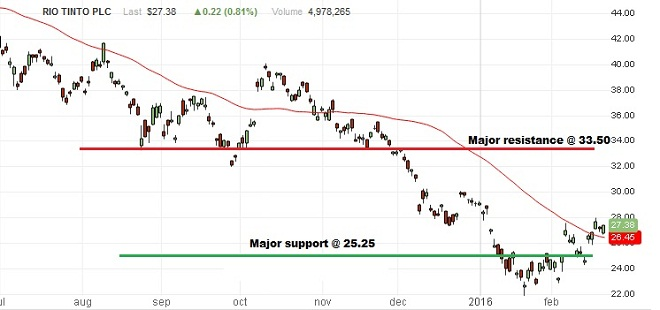
The RSI has re-tested the 50-level and is comfortably above it, thereby indicating a further uptrend in the stock price. Furthermore, the price has closed above the 50-day moving average. Thus, a binary options trader should purchase a call option with March-end expiry. The suggested strike price for the contract is $30.
Disclaimer: Any financial trading analysis offered here is our opinion and is not intended as advice or direction for investors. We cannot guarantee the success of any trades made as a consequence of this article, and we encourage traders to incorporate a strong money management strategy to limit losses when they enter the markets. Please use this article as part of your own research before formulating strategies prior to trading.