In April, oil company Pioneer Natural Resources Co. (PXD) stated that if the price of crude oil stays at or above $50 per barrel, it would consider adding five to ten rigs. Following the news, the shares of Pioneer gained about $25 to touch a 12-month high of $171.88. However, the share price continues to remain range-bound between $160 and $170 for the past one month. So, traders wonder whether it is an indication of a steep fall that is about to come or consolidation for the next rise. An answer to that lies in the minimum crude oil price required for the Pioneer to make a profit. The share price of Pioneer closed at $160.68 on Monday.
The steep decline in the crude oil prices strangled the oil companies financially and Pioneer was not an exception to that. However, the Texas-based company took smart decisions at the right time to cut operational costs, which has resulted in savings of several millions of dollars. In the past two years, through pro-active measures, the drilling and completion costs were reduced by 32%, from $1,300 to $890 per perforated lateral foot.
On a y-o-y basis, the production costs per barrel of oil equivalent (BOE) have decreased from $12.56 to $9.17 in the first quarter of fiscal 2016. For the second quarter, the company anticipates a daily production in the range of 224 to 229 MBOEPD (thousand barrels of oil equivalents per day), up from 222 MBOEPD recorded in the first quarter of fiscal 2016. The general and administrative costs reported for the first quarter was $74 million, down from $82 million in the similar period last year.
Estimates indicate that in the high yield regions, the oil companies can make a gain of 10% to 30%, even if the price of crude stays at $50 per barrel. There are companies such as Continental Resources, which claim a profit margin of 75% at the current price.
One might argue that the rise in crude prices was supported by a decline in the overall production in the US, rising demand, and supply disruptions in Nigeria and Canada. However, the price recovery has happened without any involvement of OPEC. In fact, the OPEC members continue to pump record volumes. In spite of that, the rig count in the US increased by 9 to 325 last week, the largest increase recorded since December 2015. For the rest of the year, most forecasts indicate that the crude is expected to stay between $40 and $50 per barrel. Thus, considering these facts, we can expect the company to perform well in the coming quarter. Accordingly, an increase in the share price can be expected.
Technically, the chart indicates major support for the stock at 148.50. Similarly, near 170, resistance can be expected to arise. The RSI continues to remain firm above 50. The share price also indicates bullishness by trading above the 50-day moving average. Thus, we can expect another round of uptrend in the stock very soon.
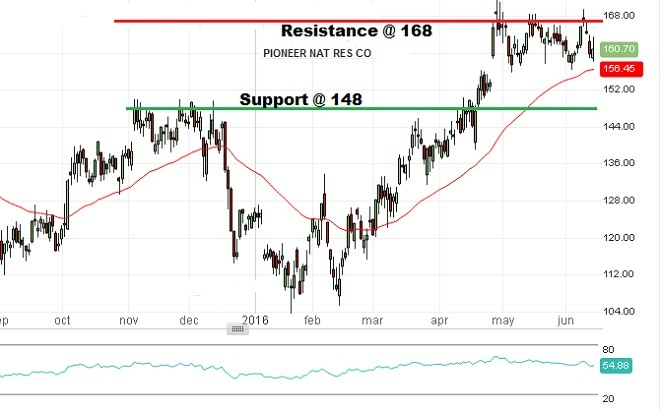
To gain from the probable uptrend, a binary trader should obtain a one-touch call option. To boost the chance of success, the recommended expiry period of the contract is mid-July, while the suggested target price is $170 or lower.
Disclaimer: Any financial trading analysis offered here is our opinion and is not intended as advice or direction for investors. We cannot guarantee the success of any trades made as a consequence of this article, and we encourage traders to incorporate a strong money management strategy to limit losses when they enter the markets. Please use this article as part of your own research before formulating strategies prior to trading.