
Pinterest (NYSE: PINS) reported mixed fiscal 2023 fourth-quarter results. While earnings surpassed Wall Street expectations, revenues missed The Street estimates. The social media platform provider also issued a lower-than-anticipated Q1 revenue outlook. Furthermore, during the investor call, the company’s CEO, Bill Ready, revealed an interesting partnership with Google. The stock of Pinterest closed Friday’s trading session at $36.87, down $3.85, or 9.45%, from the prior close.
The San Francisco, California-based image-sharing platform provider reported fourth-quarter revenues of $981.30 million, an increase of 12% from $877.20 million in the comparable quarter of fiscal 2022.
For the fourth quarter, which ended December 31, 2023, Pinterest posted net income of $201 million, or $0.29 per share, a 1,050% increase from $17.49 million, or $0.03 per share, in the fourth quarter that ended December 31, 2022.
Excluding share-based compensation, amortization of acquired intangible assets, and restructuring charges, among others, Pinterest recorded 4Q 2023 non-GAAP income of $366.25 million, or $0.53 per share, compared with $203.11 million, or $0.29 per share, in 4Q 2022.
Analysts surveyed by LSEG (formerly Refinitiv) had anticipated the company to report earnings of $0.51 per share on revenues of $991 million.
Commenting on the results, Pinterest CEO, Bill Ready, stated, “2023 was our most productive year yet as we accelerated our product velocity and launched more solutions than ever before. Pinterest is a rare business where the interests of users and advertisers are aligned. It’s proven to be true as we continue to post double-digit revenue growth and have achieved an all-time high for global MAU.”
Geographically:
- US and Canada revenues grew by 8% y-o-y to $779 million.
- Europe revenues surged 32% y-o-y to $162 million.
- Rest of World revenues were $41 million compared with $32 million last year.
During Q4, Pinterest saw an 11% y-o-y increase in Monthly Active Users (MAU) to 498 million, surpassing forecasts of 487 million. Furthermore, the company’s global average revenue per user (ARPU) stood at $2 in the recent quarter, missing forecasts of $2.05.
The company’s CFO (Chief Financial Officer) Julia Brau Donnelly, pointed out that food and beverage advertising decreased in Q4 2023, but Q1 has begun well.
The company’s Q4 costs declined by roughly 10% y-o-y to $785 million, primarily led by a drop in sales and marketing expenses.
Looking ahead, Pinterest forecasts first-quarter revenue to be between $690 million and $705 million, translating to a projected annual growth of 15% to 17%. The mean figure is $697.50, which is below Wall Street forecasts of $703 million.
During the investor call, the CEO announced the company’s ongoing development of an AI-driven automated advertising system. Specifically, he mentioned that Google would join Pinterest as a third-party advertising integration partner. The forthcoming integration with Google mirrors Pinterest’s collaboration with Amazon, with a focus on facilitating third-party advertisements.
Ready further revealed that the integration with Google was implemented “a couple of weeks ago,” noting its positive impact on “third-party advertising demand.” Although it did not notably contribute to Pinterest’s revenue in the fourth quarter, he expressed optimism that it could play a more substantial role in the first quarter and beyond.
The mixed quarterly results, weak Q1 outlook, and ad system partnership with Google are expected to keep Pinterest stock range-bound in the short term.
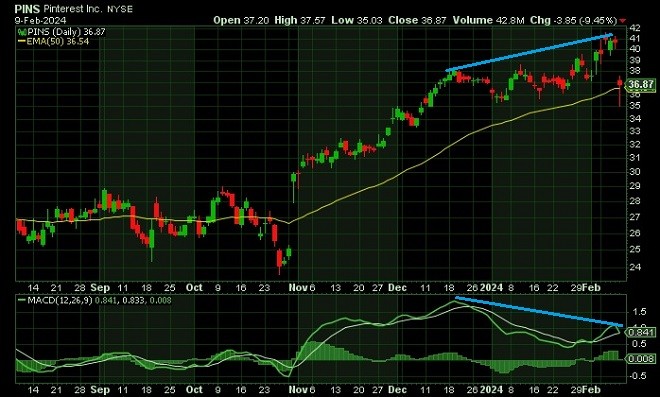
The historical price chart indicates that the stock price of Pinterest has formed a bearish gap pattern. The MACD indicator has made a negative divergence with the price. Therefore, we anticipate Pinterest’s stock to remain in a downtrend in the near term. It will be prudent to open a short position after the price breaks below the 50-day moving average.
Disclaimer: Any financial trading analysis offered here is our opinion and is not intended as advice or direction for investors. We cannot guarantee the success of any trades made as a consequence of this article, and we encourage traders to incorporate a strong money management strategy to limit losses when they enter the markets. Please use this article as part of your own research before formulating strategies prior to trading.