On Wednesday, Motorcar Parts of America (NASDAQ: MPAA), the manufacturer and distributor of automotive parts, reported a better than anticipated revenue in the fourth quarter of fiscal 2016. In a matter of two days, the rally triggered by the results took the share price to $32, from a low of $25.50. We believe that any downtrend should be used only as an opportunity to exit the short position, and the reasons for this are explained below.
For the fiscal 2016 fourth-quarter, the company recorded adjusted revenue of $100.94 million, compared to $90.90 million reported in the fourth quarter of the previous fiscal year. The fourth-quarter revenue exceeded the analyst estimates of $99.5 million.
The fourth-quarter non-GAAP net income of $9.5 million or $0.50 per share was below the non-GAAP net income of $9.9 million or $0.53 per share reported in the similar period last year. The non-GAAP net income also came below the analyst estimate of $0.53 per share.
For fiscal 2016, the adjusted revenue increased to $383.33 million, from $320.75 million recorded in the prior fiscal year.
The adjusted net income for fiscal 2016 increased to $39.63 million or $2.08 per share, from $32.86 million or $1.87 per share reported in fiscal 2015.
The Torrance, California-based company’s board has also authorized a stock repurchase program of $10 million. The program replaces the existing $5 million repurchase program announced six years earlier.
The company continues to report solid revenue growth and an increase in net income. The debt levels are also reasonable. Motorcar Parts increased its market share through offerings such as wheel hub and brake master cylinder. The increasing number of aging vehicles also adds to the prospects of revenue growth.
The company has carved a name for itself in customer service and quality assurance initiatives. To sustain growth, they continue to make investments for innovations. A week ago, Roth Capital, the investment research firm, reiterated its “buy” rating on Motorcar Parts. Thus, considering the fundamentally strong position, the probability of an uptrend in the share price is higher.
Technically, as the chart indicates, the stock bounced off the support at 28. The stochastic indicator is rising after forming a positive divergence with the price. Thus, we can expect the stock to reach the next resistance at 36.
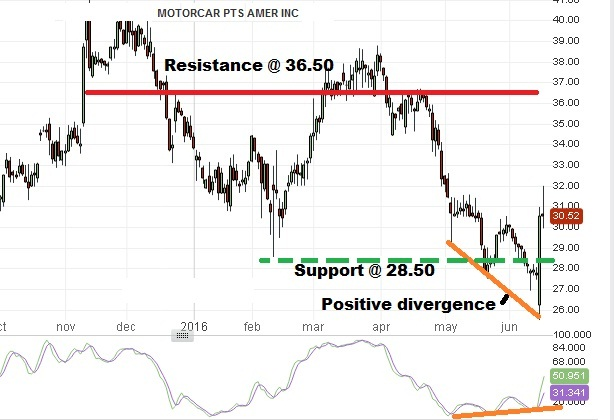
Binary options traders could profit by purchasing a one-touch call option from any suitable broker. The ideal strike price for the trade is $36 or lower. A mid-July expiry period would also heighten the chances of success in the trade.
Disclaimer: Any financial trading analysis offered here is our opinion and is not intended as advice or direction for investors. We cannot guarantee the success of any trades made as a consequence of this article, and we encourage traders to incorporate a strong money management strategy to limit losses when they enter the markets. Please use this article as part of your own research before formulating strategies prior to trading.