

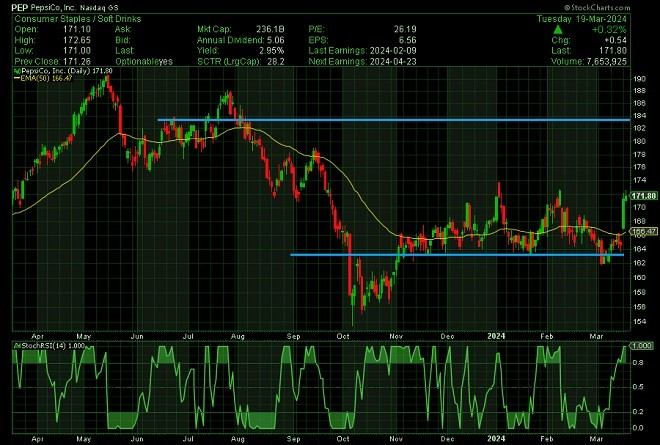
The stock of PepsiCo (NASDAQ: PEP) garnered the market’s attention after Dara Mohsenian, an analyst at Morgan Stanley (NYSE: MS), upwardly revised the food and beverage company’s rating to “Overweight” from “Equal-weight”, pointing to significant undervaluation alongside a robust long-term business strategy and clear signs of progress. The stock ended Tuesday’s trading at 171.80, up $0.54, or 0.32%, from the prior close.
Dara Mohsenian anticipates a shift in Pepsi’s relative pricing ability to a positive from the current negative trajectory. Furthermore, the analyst expects Pepsi to outperform its peers in the retail packaged goods sector, particularly in the nibble food and beverage segments. Importantly, there are signs of improvement in PepsiCo’s worldwide performance.
Mohsenian noted that the market has not fully incorporated this international growth potential, as it tends to concentrate excessively on US scanner information, which has been weaker than anticipated in the first quarter. However, this presents an opportunity for investors in PepsiCo’s shares. Additionally, Mohsenian mentioned that the long-term threats associated with GLP-1 are already factored into PepsiCo’s prevailing market price.
Morgan Stanley holds the perspective that equity investors can acquire Pepsi’s share at a historically low valuation compared to its peers. This presents a favorable opportunity for potential investors, as the market’s attention on recent documented setbacks contrasts with the expected forward trajectory expected to commence following subdued first-quarter results.
This action bolsters PepsiCo to the leading position within both the cool drinks division and the broader market, displacing not only Constellation Brands (NYSE: STZ) in beverages but also Colgate (NS: COLG) for the all-inclusive top position.
The upward revision stems from multiple pivotal developments within the company. After the release of the 2Q23 earnings report, Morgan Stanley had downwardly revised Pepsi’s rating to “Equal-weight”, citing worries regarding valuation and an overwhelmingly bullish outlook on organic sales growth (OSG).
Subsequent to the downward revision, the concerns that precipitated it have been resolved, nudging Morgan to advise purchasing PepsiCo shares in anticipation of a favorable turnaround in the latter part of the year. This is expected to occur following the stabilization of PepsiCo’s fundamentals in the initial quarter.
Dara Mohsenian identifies several indicators signaling an imminent core shift for Pepsi. These indicators encompass a notable decline in organic sales growth (OSG) in 4Q 2023, marking the first such occurrence in seven years; a pronounced slowdown in OSG from 4Q 2023 to 1Q 2024; a downward adjustment of the FY 2024 OSG projection; and a weaker-than-anticipated beginning to 1Q 2024.
Notwithstanding these obstacles, the company anticipates that Pepsi’s organic sales growth (OSG) will reach its lowest point at 2.3% in 1Q 2024, with a subsequent rebound to barely surpass peer and analysts’ OSG figures by year-end. There is a possibility of achieving OSG rates of 5% to 6% in both 3Q 2024 and 4Q 2024.
Based on the above facts, Dara Mohsenian issued a price target of $190 for the stock while upwardly revising the company’s rating. Additionally, Mohsenian also called PepsiCo Morgan Stanley’s top pick. Notably, the Seeking Alpha Quant Rating for PepsiCo is flashing Buy.
The rating upgrade is expected to keep the stock of PepsiCo slightly bullish in the near term.
The historical price chart indicates that the stock of Pepsi is ascending after testing support at $166. The next resistance is anticipated to be only near $182. Additionally, the stock is trading above its 50-day moving average, while the Stochastics RSI is in the bullish zone. Therefore, we anticipate Pepsi’s stock to remain in an uptrend in the near term.
Disclaimer: Any financial trading analysis offered here is our opinion and is not intended as advice or direction for investors. We cannot guarantee the success of any trades made as a consequence of this article, and we encourage traders to incorporate a strong money management strategy to limit losses when they enter the markets. Please use this article as part of your own research before formulating strategies prior to trading.


