Microsoft (NASDAQ: MSFT) received the market’s attention yesterday, unfortunately, for the wrong reasons. The tech behemoth issued a downwardly revised FY 2022 fourth-quarter earnings and revenue outlook. Following the downward revision, the stock dipped to a low of $261.60 before rebounding to end the trading session at $ 274.58, almost unchanged from the prior close.
The Redmond, Washington-based company now expects fourth-quarter revenue to be between $51.94 billion and $52.74 billion, down from the prior revenue outlook range of $52.40 billion to $53.20 billion.
The tech company also expects a negative currency conversion impact of $460 million. Correspondingly, Microsoft now forecasts fourth-quarter earnings in the range of $2.24 to $2.32 per share, a downward revision from the earlier guidance range of between $2.28 and $2.35 per share.
Also, segment-wise, Microsoft expects productivity and business processes revenue to be between $16.48 billion and $16.73 billion in the fourth quarter. The prior outlook range was $16.65 billion to $16.90 billion.
Intelligent cloud revenue is forecast to be in the range of $20.92 billion to $21.17 billion. The earlier projection was $21.10 billion to $21.35 billion.
More personal computing revenue is anticipated to be between $14.54 billion and $14.84 billion. The company had issued $14.65 billion to $14.95 billion earlier.
The downward revision has come only a week after a report published on Bloomberg indicated that the company has decided to slow down the hiring process in its Office, Windows, and Teams divisions. It’s possible that the hiring freeze isn’t affecting the whole organization. However, the three aforesaid divisions have played a pivotal role in fueling growth in the past few years.
Specifically, the Bloomberg article mentions that the enterprise is starting to adjust its staffing preferences as it struggles with an unpredictable world economy. Notably, fresh hiring requires the approval of the Executive Vice President Rajesh Jha and the associated management staff.
Earlier in May, there were news reports that the company is planning to almost double its budget for salary expenses and also boost the spectrum of employee stock options by a minimum of 25%. As per Payscale, a Microsoft employee gets an annual salary of $122,987, in addition to a $14,000 bonus.
In the latest quarter, the company’s quarterly revenue got a boost from the productivity and business segment (Office 365) as revenues surged 17% y-o-y to $15.80 billion. Also, Microsoft’s More Personal Computing division, which includes Xbox, Windows, search, and Surface, increased 11% y-o-y to $14.50 billion, driven by a 23% increase in search and news advertising revenue. As a whole, the third-quarter revenue was $49.40 billion, fueled by a 32% y-o-y jump in cloud-linked revenue.
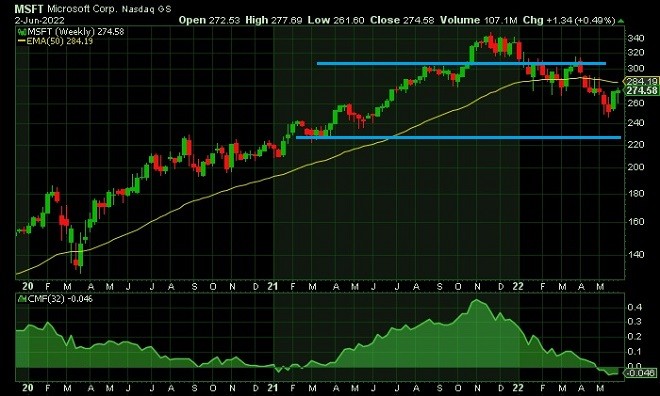
The downward revision of quarterly guidance is expected to keep the stock range-bound with a slight bearish bias in the short term.
The historical price chart indicates that the stock of Microsoft is declining after facing resistance at 300 levels. The next major support is anticipated only near 230. Additionally, the stock is trading below its 50-day moving average, while the Chaikin Money Flow indicator has a negative reading. Therefore, we are anticipating the stock to remain in a downtrend in the short term.
Disclaimer: Any financial trading analysis offered here is our opinion and is not intended as advice or direction for investors. We cannot guarantee the success of any trades made as a consequence of this article, and we encourage traders to incorporate a strong money management strategy to limit losses when they enter the markets. Please use this article as part of your own research before formulating strategies prior to trading.