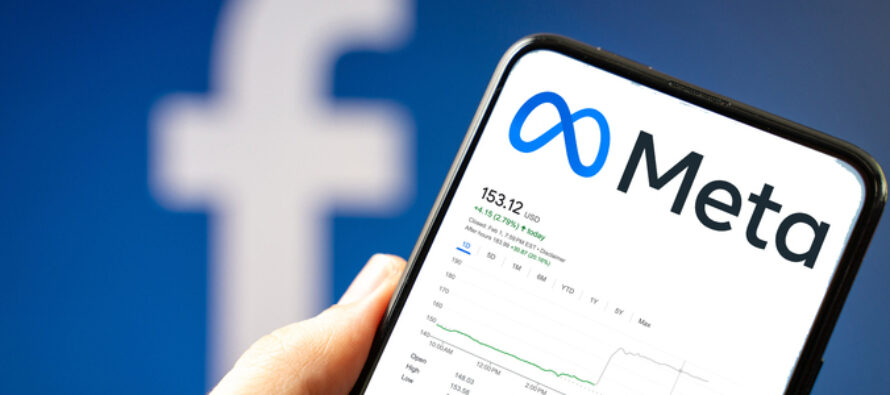
The stock of Meta Platforms Inc (Nasdaq: META), the holding company of Facebook, drew the market’s attention Thursday after the company announced its plan to increase its share repurchase plan by $40 billion while reporting better than anticipated fiscal 2022 fourth-quarter results. The share price of Meta ended Thursday’s trading session at $188.77, an increase of $35.65 or 23.28% from the prior close.
Menlo Park, California-based Meta reported fourth-quarter revenues of $32.17 billion, a decline of 4.50% from $33.67 billion in the comparable quarter of fiscal 2021. The reported figure represents the third successive quarter of a decline in sales. Also, the company’s cost and expenses surged 22% y-o-y to $25.80 billion.
For the fourth quarter ended December 31, 2022, the company recorded a net income of $4.65 billion, or $1.76 per share, compared with a net income of $10.29 billion, or $3.67 per share, in the fourth quarter ended December 31, 2021.
Analysts polled by Refinitiv had anticipated that Meta would report earnings of $1.76 per share on revenues of $31.53 billion.
During 4Q 2022, the company incurred restructuring charges for apps such as Segment and Reality Labs of $3.76 billion and $440 million, respectively. Therefore, the quarterly earnings per share are not comparable to the estimates of analysts.
Segment wise:
- Advertising revenues fell by 4.20% y-o-y to $31.25 billion.
- Reality Labs’ revenues were $727 million, a decrease of 17.10% from last year.
- Other revenues increased to $184 million, from $155 million.
Daily active users (DAUs) increased 4% y-o-y to 2 billion, surpassing the Wall Street estimate of 1.99 billion. However, monthly active users (MAUs), which rose by 2% to 2.96 billion, missed the Street estimate of 2.98 billion. The average revenue per user was $10.86, versus the $10.63 forecast by StreetAccount analysts.
Meta also revealed that it lost $13.70 billion last year in its metaverse business division. In 2022, Meta repurchased $28 billion worth of shares. Notably, the social media platform provider started purchasing shares six years ago, as per FactSet and stepped up quarterly repurchases to cross the $10 billion level in 2021. The increase in share repurchases was aided by the pandemic-fueled growth of the company’s net income. However, Meta has yet to begin paying dividends to shareholders.
Looking ahead, Meta forecasts 1Q 2023 revenues in the range of $26 billion to $28.50 billion. Analysts are projecting revenues of $27.10 billion. Back in 1Q 2021, Meta posted revenues of $27.90 billion. A revenue beat in the current quarter will imply a reversal of fortunes after a series of year-on-year revenue declines.
The company now anticipates its total expenses in FY 2023 to be between $89 billion and $95 billion, considerably lower than its earlier outlook of $94 billion to $100 billion. Meta has clarified that a slower-than-anticipated increase in payroll expenses and revenue costs is the reason for the revision of the expense outlook.
Furthermore, the company also lowered its FY 2023 capital expenditure forecasts to a range of $30 billion to $33 billion, from $34 billion to $37 billion. The downward revision is due to anticipated savings from a different cost-efficient strategy employed for the construction of its data center.
Meta also boosted its stock repurchase plan by $40 billion. In 2022, the company bought back shares worth $27.90 billion.
The impressive quarterly results and increase in allocation for the share repurchase plan are expected to keep the share price of Meta slightly bullish in the short term.
The historical price chart indicates that the stock of Meta has broken the resistance at 170. The stock is also trading above its 50-day moving average, while the Chaikin money flow indicator is showing a positive reading. Therefore, we anticipate the share price of Meta to appreciate further in the short term.

Disclaimer: Any financial trading analysis offered here is our opinion and is not intended as advice or direction for investors. We cannot guarantee the success of any trades made as a consequence of this article, and we encourage traders to incorporate a strong money management strategy to limit losses when they enter the markets. Please use this article as part of your own research before formulating strategies prior to trading.