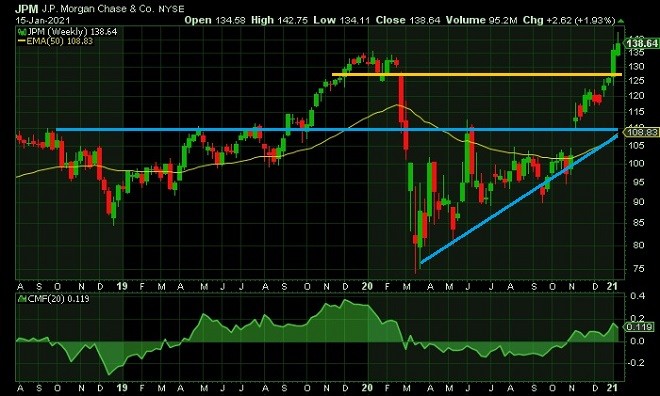
JPMorgan Chase & Co (NYSE: JPM) reported its fiscal 2020 fourth-quarter results that comfortably surpassed Wall Street estimates mainly due to the trading division’s breathtaking performance and a lift from releasing funds earlier reserved for loan write-offs. Despite the upbeat results, the stock lost 1.79% or $2.53 to close at $138.64.
The New York-based bank reported fourth-quarter revenue (managed) of $30.161 billion, compared with $29.165 billion in the comparable quarter of fiscal 2019. Analysts polled by Refinitiv had anticipated the company to post revenues of $28.70 billion for the reported quarter. Net income (reported basis) in 4Q 2020 was $29.20 billion, an increase from $28.30 billion last year.
For the fourth quarter of fiscal 2020, the bank posted net income of $12.136 billion, or $3.79 per share, an increase of 42% from $8.520 billion, or $2.57 a share in the four-quarter of fiscal 2019. Analysts polled by Refinitiv anticipated the company to post earnings of $2.62 per share for the quarter.
The banking behemoth pointed out that 4Q 2020 results include $2.90 billion released from the tons of cash reserved for anticipated loan defaults in the latest quarter. That lifted earnings by about $1.90 billion, or $0.72 per share, after write-offs of $1 billion. Even after excluding the $0.72 per share earned from the release of a portion of credit reserves, the company would have beaten analysts’ estimates for the quarter.
During the quarter, credit loss provision was a positive (benefit) $1.90 billion due to reserve releases, compared with a negative (charge) of $1.40 billion in the previous year.
Commenting on the results, Jamie Dimon, CEO of JP Morgan, said: “JPMorgan Chase reported strong results in the fourth quarter of 2020, concluding a challenging year where we generated record revenue, benefiting from our diversified business model and dedicated employees.”
Segment-wise,
- Consumer & Community Banking (CCB) revenues declined 8% y-o-y to $12.728 billion. The decrease was mainly due to deposit margin contraction, partially offset by an increase in deposit balances.
- Corporate & Investment Bank (CIB) revenues were $11.352 billion, up 17% from last year.
Banking revenue grew 16% to $4.10 billion. Within the banking revenue, investment banking revenue increased 37% to $2.50 billion.
Markets & securities services revenue increased by 18% to $7.20 billion. Within this division, market revenue rose by 20% to $5.90 billion. Fixed income markets revenue increased 15% to $4 billion but missed the $4.12 billion revenue forecast by Refinitiv. Equity markets revenue appreciated 32% to $2 billion and surpassed the $1.84 billion revenue anticipated by analysts surveyed by Refinitiv. Securities services revenue, however, declined 1% to $1.10 billion.
- Commercial Banking (CB) revenues were $2.463 billion, an increase of 7% from 4Q19. A rise in deposit balances and fees, an increase in lending revenue due to growth in portfolio spreads, and a rise in investment banking revenue contributed to overall growth.
- Asset & Wealth Management (AWM) revenues increased by 10% y-o-y to $3.867 billion. The growth was led by improved performance and higher administration charges, in addition to an increase in deposit and loan balances.
Non-interest revenue rose by 13% to $16.80 billion in the fourth quarter. Net interest income declined 7% to $13.40 billion, mainly due to low-interest rates, partially negated by the balance sheet’s growth and increased net interest income (CIB Markets). Non-interest expense decreased 2% to $16 billion.
JP Morgan revealed that it finished FY 2020 with a CET1 ratio of 13.1% and capital of over $200 billion, enabling the Group to spend on business expansion and communities while returning capital and increasing shareholder value.
Last month, JP Morgan announced a share repurchase program worth $30 billion, after the US Fed gave the green light to share repurchases in the first quarter. The company’s CFO, Jennifer Piepszak, informed reporters that the bank could buy back up to $4.50 billion worth of stocks in the first quarter.
The quarterly earnings beat and restart of the share repurchase program are expected to turn the stock range-bound with a slight bullish bias quickly.
The stock has broken above the ascending triangle at 108. There exists minor support at 125. Additionally, the Chaikin money flow indicator also has a positive reading. Therefore, we are anticipating the stock to rally further in the days ahead.
Disclaimer: Any financial trading analysis offered here is our opinion and is not intended as advice or direction for investors. We cannot guarantee the success of any trades made as a consequence of this article, and we encourage traders to incorporate a strong money management strategy to limit losses when they enter the markets. Please use this article as part of your own research before formulating strategies prior to trading.