The US earnings season has begun and the much-awaited 1Q19 earnings report of the biggest US bank by assets, JPMorgan Chase & Co. (NYSE: JPM), has been released. The major lender reported a record 1Q19 profit and revenue that surpassed analysts’ anticipations as the bank capitalized on higher interest rates.
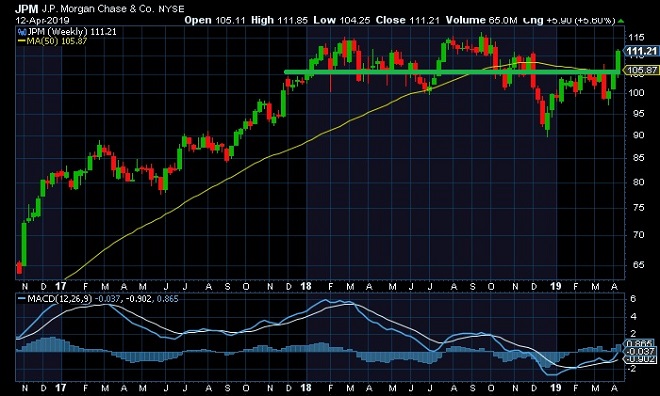
Notably, the bank did not meet expectations in the previous quarter after surpassing analysts’ estimates for 15 successive quarters in a row. The stock closed at $111.21, up to $4.98 or 4.69% from the prior close.
The New York-based bank reported 1Q19 revenues of $29.8510 billion, up 5% from $28.520 billion in a similar period last year. Analysts had anticipated the investment banking giant to post revenues of $28.40 billion, down by about 0.3% from the prior quarter. The 8% growth in net interest income to $14.60 billion, mainly due to higher interest rates that aided the increase in revenues.
For the quarter ended March 31st, 2019, JP Morgan posted earnings of $9.179 billion, or $2.65 per share, an increase of 5% from $8.712 billion, or $2.37 per share in the first quarter of 2018. Analysts had forecast earnings of $2.35 per share for the recent quarter.
Segment-wise
- Consumer & Community Banking revenue – $13.751 billion, up 9% on y-o-y
- Specifically, Consumer & Business Banking – $6.568 billion, an increase of 15% from $5.722 billion.
The bank’s retail lending business recorded a profit of $3.96 billion up 19% from last year. The increase in lending across auto and credit card business was supported by a steady rise in profit margins on deposits. Notably, the provision for credit losses remained unchanged from last year at $1.3 billion.
- Corporate & Investment Bank – $9.848 billion, down 6% from $10.483 billion.
- Banking – $3.23 billion, an increase of 8% from $3.005 billion.
Markets & investor services – $6.616 billion, down 12% from $7.478 billion.
Fixed trading revenue declined 8% y-o-y to $3.70 billion. Lower revenue from currency and emerging markets was the main reason for the decline. Likewise, equity markets revenue fell 13% to $1.70 billion. Lower client activity in the derivatives market was responsible for the poor performance. However, Investment banking revenue increased 10% y-o-y to $1.70 billion, led by a strong performance of the debt underwriting division.
In February, the largest credit card issuer in the US cautioned that 1Q19 trading revenue might record a “high-teens” percentage fall from the prior-year period as both equities and fixed income desks faced difficulties due to weak client activity.
This caution turned out to be true. J.P. Morgan’s investment bank, the world’s largest by revenue, recorded a 17% decline in its first-quarter trade revenue to $5.5 billion. Bond trading fell 8%, and stock trading revenue dropped 13%, excluding the effects of a previous accounting change. Banking revenue grew 8% to 3.2 billion dollars with an increase in debt underwriting and advisory charges. The division’s total profit of $3.25 billion was 18% lower compared to last year.
- Commercial Banking – $2.338 billion, an increase of 8% on a y-o-y basis.
- Asset & Wealth Management – $3.489 billion, slightly down from $3.506 billion in the year-ago period.
Commenting on the results, CEO Jamie Dimon said: “We had record revenue and net income, strong performance across each of our major businesses and a more constructive environment. Even amid some global geopolitical uncertainty, the U.S. economy continues to grow, employment and wages are going up, inflation is moderate, financial markets are healthy and consumer and business confidence remain strong.”
The Impressive results may remove concerns about the industry after the Federal Reserve hinted that it does not foresee any rate hikes for the rest of the year. In combination with indications of a global downturn, the decisions of the Central Bank have put the bank stocks in trouble, as the inverted yield curve crumples the gross margins of the sector and indicates a probable contraction on the horizon. However, the results of JP Morgan have shown that it continues to generate profits even after the fourth rate hike that was announced in December 2018 by the Fed.
Nevertheless, the bank did not refrain from making long-term investments to spur growth. By 2022, JP Morgan expects to have branches far enough to cover the length and breadth of the entire US. Recently, JP Morgan also launched the first US bank’s crypto-currency and committed 350 million dollars to beef up job prospects in under privileged communities.
Commenting on the results, KBW analyst Brian Kleinhanzl said: “JPMorgan had a positive read-across for trading results in the quarter. We believe FICC (fixed income, commodities and currencies) trading should be a positive read-across to Goldman Sachs and Morgan Stanley.”
The overwhelmingly positive results are expected to keep the stock bullish in the short term.
The price chart indicates that the stock has crossed above its 50-day moving average. Furthermore, the MACD indicator has a positive reading. The stock also has firm support at 106 levels. As a result, we can anticipate a rally to begin in the days to come.
Disclaimer: Any financial trading analysis offered here is our opinion and is not intended as advice or direction for investors. We cannot guarantee the success of any trades made as a consequence of this article, and we encourage traders to incorporate a strong money management strategy to limit losses when they enter the markets. Please use this article as part of your own research before formulating strategies prior to trading.