
Intel Corp (Nasdaq: INTC) released better-than-expected FY 2021 second-quarter revenues and earnings. The company also lifted its FY21 earnings and revenue outlook. However, the chip maker’s third-quarter non-GAAP gross margin forecast was unexpectedly on the lower side in comparison to the reported second-quarter margins.
The weak margin outlook paved the way for a sell-off on Friday, with the stock closing at $53, down $2.96 or 5.29% from the prior close.
The California-based company released second-quarter revenues of $19.631 billion, compared with $19.728 billion in the similar period the previous year.
Excluding the NAND memory business, Intel posted Q2 2021 revenues of $18.533 billion, up from $18.184 billion in Q2 2020. Refinitiv analysts had expected the company to report revenues of $17.58 billion for the second quarter.
For the June 26th, 2021 quarter the company recorded a net income of $5.061 billion, or $1.24 per share, an increase from $5.105 billion, or $1.19 per share for the June 27th, 2020 quarter.
Excluding restructuring charges, acquisition related-adjustments, NAND memory business, and ongoing mark-to-market on marketable equity securities, Intel reported 2Q 2021 non-GAAP net income of $5.241 billion, or $1.28 per share, compared with $4.901 billion, or $1.14 per share, in 2Q 2020. The reported earnings surpassed the earnings of $1.06 per share anticipated by analysts polled by Refinitiv.
Pat Gelsinger, Intel CEO, commented on the results: “Our second-quarter results show that our momentum is building, our execution is improving, and customers continue to choose us for leadership products.”
Segment-wise,
- Client Computing Group revenues increased 6.4% y-o-y to $10.109 billion. Interestingly, the average price of chips sold by Intel decreased in spite of the increase in revenues.
- Data Center Group revenues declined 9.30% y-o-y to $6.455 billion. The decline was mainly due to the loss of market share to AMD (Advanced Micro Devices).
- Internet of Things revenues were $1.311 billion, up 60.66% from last year. Specifically, IOTG (division sells embeddable chips) revenues were $984 million (against $670 million), and Mobileye revenues were $327 million (versus $146 million, reflecting 124% y-o-y growth). Intel hopes to become a major supplier of chips to manufacturers of self-driving cars.
- Non-volatile memory solutions group revenues were $1.098 billion, a decrease of 33.80% on a y-o-y basis.
- Programmable solutions group revenues declined by $15 million to $486 million.
The CEO expects chip scarcity to “bottom out” in 2H 2021. It can be remembered that the company had announced its intention to start manufacturing chips for other companies. However, the plan has run into trouble as the company has postponed the launch of its next-generation server chips to the beginning of 2022.
Furthermore, as part of the restructuring, Navin Shenoy – chief of server business- exited from the company after serving for about 26 years.
Looking ahead, the company boosted its FY 2021 earnings and revenue outlook. Intel now anticipates earnings of $4.09 per share and adjusted earnings of $4.80 per share for fiscal 2021. This compares with the adjusted earnings forecast of $4.60 per share issued earlier.
Likewise, the company now projects FY 2021 revenues of $77.60 billion and non-GAAP revenues of $73.5 billion. Previously, Intel had forecast GAAP revenues of $77.0 billion and non-GAAP revenues of $72.50 billion for the current fiscal year. Analysts surveyed by Thomson Reuters anticipate Intel to post FY 2021 adjusted earnings of $4.62 per share on non-GAAP revenues of $73 billion.
The company also stated that it anticipates non-GAAP gross margins of 55% in the third quarter, a steep decline from 59.2% in the previous quarter. Intel stated that the drop in margin was mainly due to supply issues and also expenses associated with manufacturing chips with new technology.
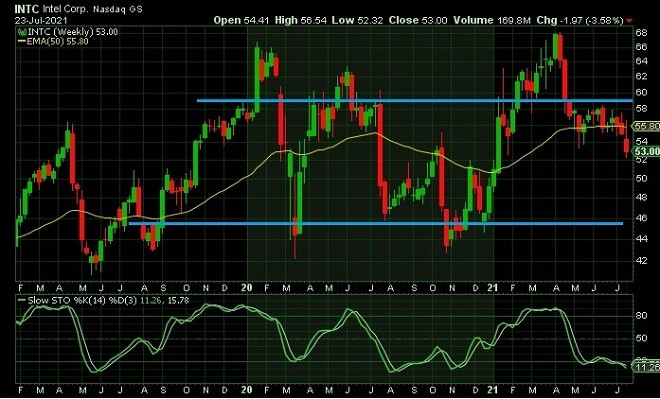
The weak Q3 margin guidance is likely to keep the stock range-bound with a minor bearish bias, in spite of reporting better-than-anticipated Q2 results and lifting the FY 2021 outlook.
The historical price chart shows that the stock of Intel is dropping after failing to break the resistance at 60. The next major support is expected near 46. The stock has also closed below its 50-day moving average. Furthermore, the stochastics indicator is in the bearish zone. We are therefore expecting the stock to continue in a downtrend in the short term.
Disclaimer: Any financial trading analysis offered here is our opinion and is not intended as advice or direction for investors. We cannot guarantee the success of any trades made as a consequence of this article, and we encourage traders to incorporate a strong money management strategy to limit losses when they enter the markets. Please use this article as part of your own research before formulating strategies prior to trading.