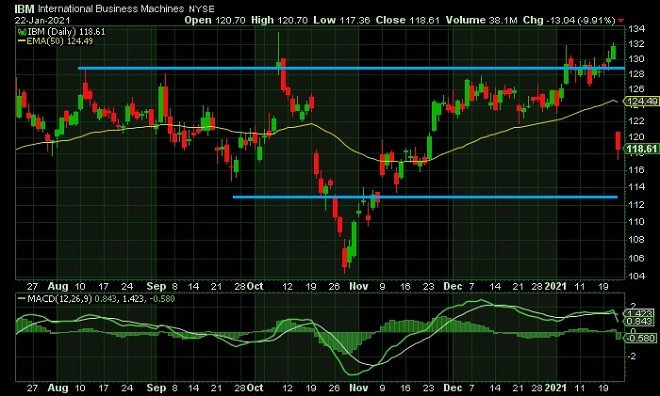
Software giant IBM, Inc. (NYSE: IBM) reported mixed fiscal 2020 fourth-quarter results. While the earnings surpassed Wall Street estimates, revenues failed to meet the expectations of analysts. The company clarified that the decline in revenues was mainly due to restrictions enforced to contain the COVID-19 pandemic, as that caused a postponement in inking long-term agreements. Following the mixed quarterly results report, the stock lost 9.91% or $13.04 to close at $118.61.
Armonk, New York-based IBM, reported a decline in the fourth-quarter revenues to $20.367 billion, from $21.777 billion in a similar period last year. Analysts surveyed by Refinitiv had anticipated the company to post revenues of $20.67 billion for the quarter.
For the sixth quarter in a row, the company’s revenues have declined. The 6% fall in revenues is the steepest in five years.
Regarding the decline in revenues, Jim Kavanaugh, IBM’s CFO, clarified as follows: “The challenging environment we have seen since March continued with the shift in clients buying behaviors and priorities.”
For the quarter ended December 31, 2020, the company earned $1.356 billion, or $1.51 per share, compared with $3.670 billion, or $4.11 a share, in the quarter ended December 31, 2019.
Excluding charges, Q4, 2020 income from continuing operations was $1.861 billion, or $2.07 per share, compared with $4.206 billion, or $4.71 a share in Q4, 2019. The consensus estimate called for earnings of $1.79 per share for the reported quarter.
IBM’s earnings per share dropped 66%, reflecting the steepest decrease in three years, mainly because of a $2.04 billion pre-tax charge for structural actions during the quarter. The charges were lower than anticipated. Back in October, the company had estimated the charges to be about $2.30 billion. IBM could not finish restructuring activities in some countries, and it anticipates finishing the leftover job in the first half of this year. That is expected to result in an additional pre-tax charge of $260-million.
The charges are related to the restructuring plan unveiled in October. This includes spinning off the company’s Managed Infrastructure Services division, which provides hosting for web-based software and web sites, in a stand-alone listed company by the end of this year. The spin-off plan reflects IBM’s first significant change since Krishna took over Ginni Rometty in April 2020. That division is currently a part of the Global Technology Services.
Segment-wise:
- Cloud & Cognitive Software revenues decreased 5% y-o-y to $6.837 billion and missed the FactSet consensus estimate of $7.18 billion. The increase was led by a 9% growth of Cloud & Data platforms (Red Hat fueled growth). Cognitive Applications revenue stood flat. Transaction Processing Platforms revenues fell by 24%. The gross profit margin increased by 20 basis points.
- Global Business Services posted revenues of $4.170 billion, down 2.7% on a y-o-y basis, but exceeded the consensus estimate of $4.08 billion. Application Management and Consulting led the decline. The gross margin increased by 260 basis points.
- Global Technology Services recorded revenues of $6.568 billion, a decrease of 6% from last year and lower than the $6.92 billion forecast by analysts. The gross margin rose by 70 basis points.
- Systems revenues dropped 18% to $2.501 billion but surpassed the Street estimates of $2.26 billion. The decline was led by Systems Hardware platforms, mirroring the negative effect of product cycles. The gross margin increased 380 basis points.
- Global Financing revenues were $286 million, compared with $301 million last year. The decline reflects the shut-down of the OEM commercial financing division.
The company refrained from issuing a formal earnings outlook but stated that it anticipates recording growth in FY 2021, in addition to free cash flow in the range of $11billion to $12 billion.
The mixed quarterly results are expected to keep the stock range-bound with a slight bearish bias.
Technically, as shown by the price chart below, the stock has closed below its 50-day moving average. The MACD indicator reading has turned negative. The next minor support for the stock is anticipated only near 112. Therefore, we are expecting the stock to decline further in the days ahead.
Disclaimer: Any financial trading analysis offered here is our opinion and is not intended as advice or direction for investors. We cannot guarantee the success of any trades made as a consequence of this article, and we encourage traders to incorporate a strong money management strategy to limit losses when they enter the markets. Please use this article as part of your own research before formulating strategies prior to trading.