
Honeywell International (Nasdaq: HON) has inked a nearly $5 billion agreement to acquire Carrier Global Corp.’s security division (Access Solutions) as the industrial behemoth initiates a spending binge to strengthen its offerings. This transaction represents Honeywell’s notable acquisition under the leadership of its current CEO, Vimal Kapur. The takeover paves the way for access to Carrier’s portfolio, including prominent brands like Onity, well-known for manufacturing electronic locks utilized by numerous leading hotel chains, and Supra, a cloud-based lock manufacturer.
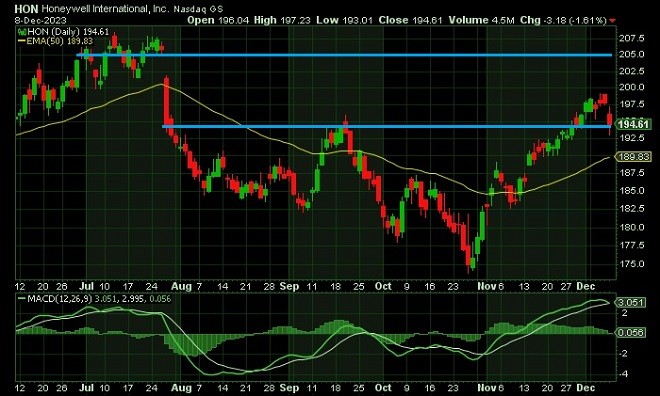
The stock of Honeywell ended Friday’s trading session at $194.61, down $3.18, or 1.61%, from its prior close. Honeywell has a market cap of $130 billion, reflecting a decline of 7% so far this year. The shares of Carrier Global Corporation (NYSE: CARR) ended Friday’s trading session at $55.27, up $2.38, or 4.50%, from their prior close.
Specifically, Charlotte, North Carolina-based Honeywell International is taking over the security division of Carrier, which comprises 1,200 employees, in an all-cash deal worth $4.95 billion. The takeover is anticipated to conclude before the end of 3Q24. Furthermore, the transaction is projected to contribute positively to the aerospace and energy company’s financial performance in its initial year of ownership.
This acquisition aligns with Honeywell’s strategic objective to solidify its growing safety business, particularly in response to recent months’ subdued growth in this sector. Honeywell’s Building Automation segment serves clients ranging from hospitals and airports to data centers. Likewise, Palm Beach Gardens, Florida-based Carrier’s Access Solutions security business delivers security systems for residential, commercial, and industrial purposes. The company’s fire and security division represented roughly 17% of its aggregate sales last year.
The acquisition is a step in Honeywell’s plan to fulfill the growing demand for cloud-based solutions. Interestingly, Honeywell’s aviation division is performing exceptionally well.
While Evercore acted as the financial advisor to Honeywell, Carrier was advised by Goldman Sachs and J.P. Morgan Securities.
Carrier has revealed its plans to set aside $4 billion from the proceeds of the sale towards debt reduction. The company has indicated that it intends to recommence stock buybacks once its leverage ratio aligns with approximately twice its yearly EBITDA (earnings before interest, taxes, depreciation, and amortization).
Honeywell Chief Executive Vimal Kapur, who took over from Darius Adamczyk in June, expressed in October the company’s strategic emphasis on developing its business within the domains of automation, aviation, and the energy transition.
The divestment agreement entered into by Carrier aligns with Honeywell’s strategic objectives to allocate a minimum of $25 billion over the upcoming three years for mergers and acquisitions, alongside commitments to dividends, capital expenses, and share repurchases.
Carrier, which commands a market cap of roughly $4 billion and is renowned for its production of air-conditioning and heating systems for both commercial and residential environments, stands as one of the three firms resulting from the separation of United Technologies in 2020. The company is still looking at various options for its commercial and residential fire divisions. Notably, Carrier has expressed its interest in acquiring Viessmann Climate Solutions, the largest business division of Germany’s Viessmann Group, for a little over $13 billion.
The acquisition is expected to boost the stock of Honeywell in the short term.
Technically, the stock of Honeywell is trading near its major support level of $194. The next resistance is anticipated to be only near $205. Additionally, the stock is trading above its 50-day moving average, while the MACD indicator is showing a positive reading. Therefore, we anticipate the stock of Honeywell to start gaining ground in the near term.
Disclaimer: Any financial trading analysis offered here is our opinion and is not intended as advice or direction for investors. We cannot guarantee the success of any trades made as a consequence of this article, and we encourage traders to incorporate a strong money management strategy to limit losses when they enter the markets. Please use this article as part of your own research before formulating strategies prior to trading.