

The stock of insurer Aon PLC (NYSE: AON) turned volatile on Thursday after the US Justice Department (DoJ) slapped them with a lawsuit to prevent the company from taking over consulting company Willis Towers Watson PLC (Nasdaq: WLTW) in a $30 billion deal.
The Justice Department, in its lawsuit, argued that the merged entity would wipe out competition in multiple markets. Aon and Willis Towers have countered the department’s allegation by stating that the lawsuit reflects a lack of awareness of their affairs, customers, and the markets in which they function.
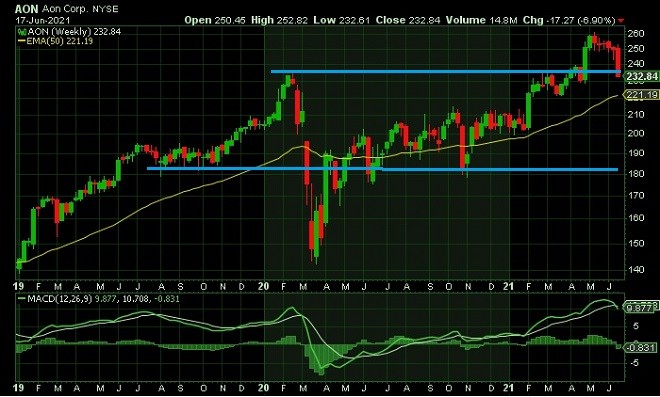
The stock of Aon closed Thursday’s trading session at $232.84, down $11.26 or 4.61% from the prior close. The stock of Willis Towers ended the day at $232.19, down $4.95 or 2.09% from earlier close.
The lawsuit was filed by the US Justice Department because the institution believes that the merger will weaken competition and could result in higher costs for clients.
The department further pointed out that the deal is about merging two of the top three (Marsh McLennan is the third insurance broker) insurance brokers of global repute.
In 2016, the plan of a merger deal came up between London-headquartered Aon and Willis. The intention was to jointly create insurance agreements for customers involving a multitude of insurers for coverage of industries such as airlines and even sporting occasions. The deal was inked last year to form the world’s biggest insurer, eclipsing Marsh & McLennan Companies.
The lawsuit refers to an unidentified Aon executive who informed friends that the deal would increase the level of leverage the firm already has. Furthermore, the executive has boasted that the firm nearly operates in a monopoly environment which very few can understand.
The lawsuit alleges five dark areas such as identification of relevant health benefit plans for top clients and programs for casualty, property, and financial risk for big clients.
Through a joint statement, both Aon and Willis have refuted the charges made by the Justice Department. The firms have claimed that the department totally lacks in-depth knowledge of the business, the customers served, and the area of operation.
Aon and Willis further claimed that the firms have made progress by having detailed interaction with regulators across the globe and remain devoted to realizing the advantage of the merger.
Earlier this month, Aon disclosed the sale of a portion of its assets to private equity company Aquiline Capital Partners and tech company Alight for $1.40 billion in what is seen as an attempt to receive clearance from the US regulators. The department has opined that the divestment initiatives are inadequate.
On his part, Attorney General Merrick Garland clarified the need to file a lawsuit by stating that the US enterprises and clients depend on the fierce competition between Aon and Willis Towers Watson to bring down costs related to critical services such as retirement and health benefits.
Earlier, the deal was anticipated to receive the endorsement from the EU after Aon came forward to divest a considerable portion of its assets.
The filing of the lawsuit by the DoJ is expected to keep the stock of Aon range-bound with a slight bearish bias.
The historical price chart indicates that the stock of Aon has started declining after failing to break the resistance level of 240. The next major support zone is 180-200 level. Additionally, the MACD indicator reading has turned negative. Therefore, we are anticipating the stock of Aon to decline further in the near term.
Disclaimer: Any financial trading analysis offered here is our opinion and is not intended as advice or direction for investors. We cannot guarantee the success of any trades made as a consequence of this article, and we encourage traders to incorporate a strong money management strategy to limit losses when they enter the markets. Please use this article as part of your own research before formulating strategies prior to trading.


