Media and entertainment giant Walt Disney Co (NYSE: DIS) surprised the market by posting a profit in the first quarter of FY 2021 versus the market’s expectations for a loss. The company’s Q1 revenue also surpassed Wall Street estimates. The company also revealed that its streaming content business Disney+ has 94.90 million subscribers. Following the unexpected quarterly profit, the stock gained $2.64 or 1.38% to close at $193.55 on Friday.
Burbank, the California-based company, reported first-quarter revenues of $16.249 billion, down 22.2% from $20.877 billion in a similar period last year. Analysts surveyed by Refinitiv had anticipated the company to report revenues of $15.90 billion for the quarter.
For the quarter ended January 2, 2021, Walt Disney reported $17 million earnings, or $0.01 per share, compared with $2.107 billion, or $1.16 a share, on December 28, 2019.
Excluding restructuring and impairment charges, among others, the company posted Q1, 2021 adjusted earnings of $588 million, or $0.32 per share, down 79% from $2.821 billion, or $1.53 a share. Economists polled by Refinitiv had anticipated the company to post a loss of $0.41 per share.
Segment-wise,
- Disney Media and Entertainment Distribution revenues decreased 5% y-o-y to $12.661 billion.
-Linear Networks posted revenues of $7.693 billion, up 2% from last year.
-Direct-to-Consumer recorded revenues of $3.504 billion, an increase of 73% from the prior year. The growth in this division enabled the company to mitigate losses in other divisions.
-Content Sales/Licensing and Other revenues fell 56% to $1.702 billion. The company had no theatrical releases during the quarter. Only home entertainment releases were there in a limited manner.
-Elimination of Intra-segment revenues decreased 37% y-o-y to $238 million.
- Disney Parks, Experiences, and Products revenues were $3.588 billion, down 53% from last year. The decline was due to the closure of several theme parks or operating at decreased capacity. Additionally, the company’s cruise ships and assisted tours remained suspended.
-Domestic revenues decreased 70% y-o-y to $1.489 billion.
-International revenues were $378 million, down 60% from the previous year.
-Consumer Products revenues increased 2% to $1.721 billion.
During the latest quarter, the COVID-19 outbreak had cost the segment about $2.60 billion in lost operating income. The company had reported comparable losses in the past three quarters. For the fourth quarter, the company stated that the COVID-19 outbreak had resulted in a loss of roughly $2.40 billion in operating income. In the second quarter, the company had lost $1billion in operating income. In the third quarter, Disney lost $3.50 billion in operating income.
During the first-quarter, Walt Disney World in Shanghai Disney Resort and Florida remained open.
The company’s performance was severely affected in the first-quarter as COVID-19 related prohibitions affected its open theme parks. Also, the continued shutdown of California parks affected the company financially.
Disney also revealed that it had added over 21 million subscribers to its Disney+ streaming service in the first quarter, taking the total number of paid subscribers to roughly 95 million. The increase has come after Disney’s free-trial period stopped for certain subscribers who were also clients of Verizon.
Average monthly revenue per paid Disney+ subscriber, nevertheless, declined 28% to $4.03, from $5.56 in the comparable quarter of fiscal 2020. The main reason for the drop was the figures include Disney+ Hotstar subscribers in India and Indonesia, where the average monthly revenue per paid subscriber is comparatively lesser than other markets of Disney+.
Excluding Hotstar, the average revenue per paid Disney+ subscriber would have been $5.37 in Q1 2021. Disney stated that the company now has over 146 million total paid subscribers throughout its streaming services at the end of first-quarter.
CEO Bob Chapek stated that the outlook for parks and other entertainment division is dependent on the speed with which vaccination gets completed.
The company anticipates capital expenditures for FY 2021 to be comparable to FY 2020, with a boost in the media and entertainment segment’s investments and a decline in the capital outlays in the parks segment.
The unexpected profit in the first quarter and substantial subscriber additions are expected to keep the stock slightly bullish in the days ahead.
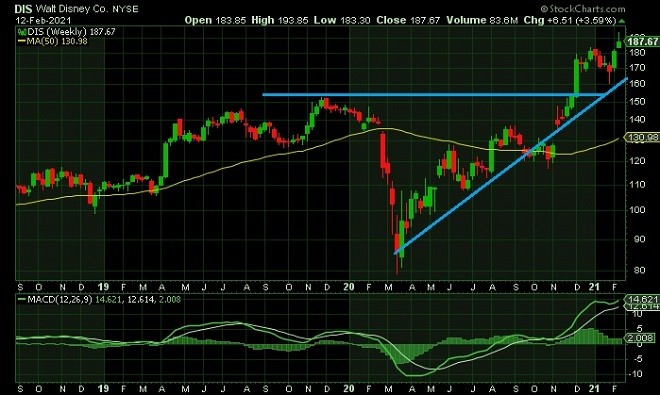
Technically, the stock has broken above the ascending triangle formation. The stock is trading above its 50-day moving average, while the MACD indicator is making new highs. Therefore, we are anticipating the stock to rally in the days ahead.
Disclaimer: Any financial trading analysis offered here is our opinion and is not intended as advice or direction for investors. We cannot guarantee the success of any trades made as a consequence of this article, and we encourage traders to incorporate a strong money management strategy to limit losses when they enter the markets. Please use this article as part of your own research before formulating strategies prior to trading.