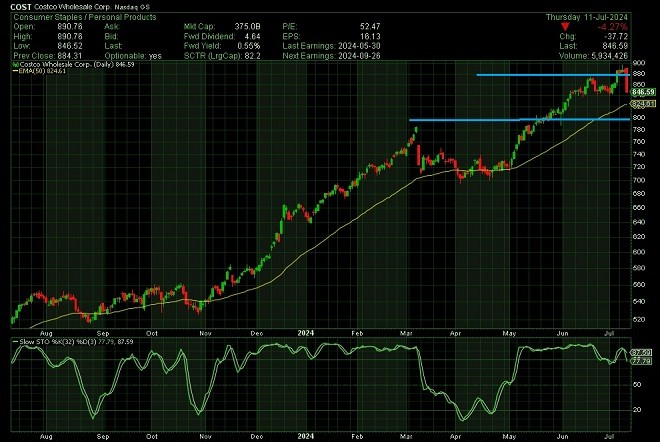
Costco Wholesale Corp. (Nasdaq: COST) garnered the market’s attention with its announcement of a membership fee increase slated for September 1 in the US and Canada. Following the membership hike announcement, the stock of Costco ended Thursday’s trading session at $846.59, down $37.72, or 4.27%, from the prior close.
Effective from that date, the Issaquah, Washington-based Company’s entry-level membership will cost an additional $5, i.e., $65 annually, up from the current level of $60. Meanwhile, its premium “Executive Membership” will see an increase from $120 to $130 per year. These adjustments are expected to impact approximately 52 million members, with more than 50% of them belonging to executive members.
This represents Costco’s initial membership fee hike in seven years, specifically since June 2017, maintaining its historical pattern of adjusting fees approximately every five and a half years. Originally, the company was on course to implement this change at the end of 2022 or the beginning of 2023 but postponed it due to economic factors. CEO Craig Jelinek and CFO Richard Galanti had previously indicated in interviews and earnings conference calls that Costco delayed the increase in response to consumer concerns over high inflation.
Membership fees constitute a significant portion of Costco’s top line and play a crucial role in keeping product prices competitive. This approach contrasts with its competitor, Walmart’s subsidiary Sam’s Club, which raised its membership fees in 2022, the first of its kind in nine years. Despite this increase, Sam’s Club’s membership fees remain lower than Costco’s, with annual costs of $50 for basic members and $110 for their premium “Plus” tier. Similarly, BJ’s Wholesale charges $55 and $110 annually for its standard and premium memberships, respectively.
To ensure the integrity of its membership system, Costco intensified measures last year to prevent unauthorized card use, including enhanced scrutiny during self-checkout processes. These efforts mirror strategies employed by other subscription-based services like Netflix, which also bolstered measures against unauthorized account sharing.
Costco’s decision to adjust membership fees reflects its ongoing strategy to balance revenue growth with customer affordability in a competitive retail environment. This move not only aims to sustain Costco’s financial health but also underscores its commitment to maintaining value for its loyal membership base amidst evolving economic conditions and consumer expectations.
The increase in membership fees is expected to keep the stock range-bound with a slight bullish bias in the short term.
The historical price chart indicates that the stock of Costco is declining after failing to break the resistance at $880. The next major support is anticipated to be only near $800. Additionally, the stochastic indicator is in the overbought region. Therefore, we anticipate Costco’s stock to remain in a downtrend for the next few trading sessions. It would be prudent to open a short position after the stock closes below its 50-day moving average.
Disclaimer: Any financial trading analysis offered here is our opinion and is not intended as advice or direction for investors. We cannot guarantee the success of any trades made as a consequence of this article, and we encourage traders to incorporate a strong money management strategy to limit losses when they enter the markets. Please use this article as part of your own research before formulating strategies prior to trading.