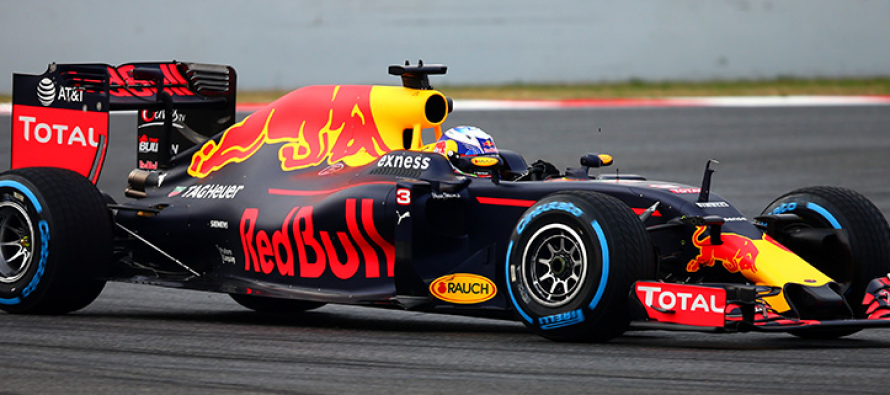
With just three weeks remaining for the fiscal 2016 third-quarter results, the stock of the integrated oil and gas company Total S.A. (NYSE: TOT) continues to trade around $48, the price where it was two months before. Ironically, the company recorded a decline in the fiscal 2016 second-quarter revenue and earnings, compared to the corresponding quarter last year. However, there are some valid reasons to forecast a further rise in the share price in the near future. The share price of Total ended Wednesday’s trading session at $48.25.
The Courbevoie, France-based company reported a 17% y-o-y decline in the second-quarter revenue to $37.22 billion. However, the Q2 revenue surpassed the Zacks estimates of $35.3 billion by 5.4%.
Total, which is one of the six ‘supermajor’ oil companies in the world, recorded second-quarter adjusted net income of $2.17 billion or $0.90 per share, compared to adjusted net income of $3.09 billion or $1.21 per share in the prior year’s similar quarter. Total also topped the Zacks adjusted earnings estimates of $0.75 per share by a margin of 20%.
The revenue and earnings were lower compared to last year. However, it should be noted that the realized Brent price in Q2 2016 was $45.60 per barrel, down 26% from $61.90 per barrel in the corresponding quarter of 2015. Even the realized average liquid price declined 26% to $43 per barrel, from $58.2 per barrel last year’s quarter. The energy market recovery in February has enabled the company to record a 34.5% and 38.7% increase in the price of oil and liquid prices respectively. The strenuous cost-cutting process undertaken by the company is beginning to pay off.
The Total is expected to benefit from a 4% anticipated increase in the production in the Upstream segment in fiscal 2016. The company is also expected to gain from the new Upstream projects (Incahuasi in Bolivia and Kashagan in Kazakhstan), which have begun their production recently. Total has plans to invest $18 billion to $19 billion in 2016.
In the second quarter, the company shipped LNG from the terminal in Angola. For the past two years, the LNG terminal remained shut down for maintenance operations. The company also won a 30% stake in the Al Shaheen oil field off the coast of Qatar. To increase the market share to 20% in the African continent, Total also acquired retail and logistics assets in Kenya, Uganda, and Tanzania. Thus, fundamentals indicate that the worst is over for the stock.
The historical price chart shows that the stock remains range-bound between 46 and 50. The rising stochastic oscillator indicates the possibility of a technical breakout. A break above the level of 50 would take the stock to the next trading range of between 56 and 60.
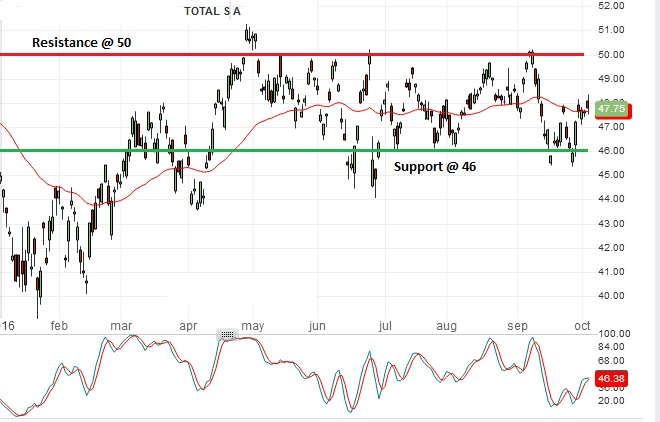
A one-touch call option with a strike price of about 56 should be picked for investment. The trader can hope the call option to finish in the money as long as the expiry date is in the first week of November. It can be noted that from November onwards, the amount of oil pumped out by OPEC members would be limited to 32.5 million to 33 million barrels per day. Such a scenario would assist the stock in breaching the strike price.
Disclaimer: Any financial trading analysis offered here is our opinion and is not intended as advice or direction for investors. We cannot guarantee the success of any trades made as a consequence of this article, and we encourage traders to incorporate a strong money management strategy to limit losses when they enter the markets. Please use this article as part of your own research before formulating strategies prior to trading.