In another sign of consolidation in the crude oil sector, ConocoPhillips (NYSE: COP) is acquiring Concho Resources Inc, the US shale oil producer, in an all-stock deal worth $9.7 billion. The acquisition, the largest in the energy sector so far this year, is expected to assist the merged entity in cementing its position in the market against the backdrop of a drop in fuel prices and demand.
The stock of Concho closed at $47.11, almost unchanged from the prior close. Likewise, the stock of ConocoPhillips closed almost flat at $32.59 from an earlier close.
As per the takeover deal, for every share held by Concho shareholders, 1.46 shares of ConocoPhillips will be given. The acquisition deal is forecast to result in annual cost and capital savings of $500 million by 2022.
The acquisition deal gives a value of $49.30 per share for Midland, Texas-based Concho, a premium of just 1.4% over Friday’s close. The deal follows other low premium energy deals in the recent past, including the merger of WPX Energy and Devon, and the acquisition of Noble Energy by Chevron.
The Houston, Texas-based ConocoPhillips clarified that the premium paid is 15% over the closing price of Concho on October 13th, before the media started publishing reports about the discussions between the management of both companies.
The takeover has come at a time when the US shale enterprises continue to accumulate huge losses due to low crude prices and face issues in raising fresh capital to reorganize the debt pile.
The acquisition would enable ConocoPhillips to stand shoulder-to-shoulder with other large players in the Permian Basin, the main US oilfield that extends from West Texas to the southeast region of New Mexico. The merged entity will also become the largest US independent firm, pumping up 1.50 million barrels per day (bpd).
Concho, being the fifth largest producer by volume in the Permian basin, pumps roughly 319,000 barrels per day, from wells scattered across approximately half a million acres. Conoco pumps roughly 50,000 bpd in the Permian but remains a top producer in two other shale fields in the US.
Commenting on the acquisition, Andrew Dittmar, M&A analyst at consultancy Enverus, said, “Concho has been on the short list of big Permian companies attracting interest due to its large production, vast acreage and relatively low debt.”
Notably, some of the well owned by Concho is on property owned by the US government. This may prove to be a blessing as Democratic party presidential candidate Joe Biden has suggested banning additional fracking licenses on federal lands.
For a while, the US energy sector has been consolidating after several shale producers started struggling to serve debts. Shale companies had borrowed huge sums of money to boost production on the premise that crude prices would strengthen. As oil fell, shale investors were left with increasing outputs and a mountain of debts.
At the end of June, Concho’s long-term debt stood at $3.90 billion. The company has not recorded a yearly profit since 2018. Concho’s second-quarter loss was $435 million, wider than the $97 million posted prior year.
Conoco highlighted that the merged entity would have control over 23 million barrels of oil equivalent resources, and the average supply cost of West Texas Intermediate crude will be lower than $30 per barrel.
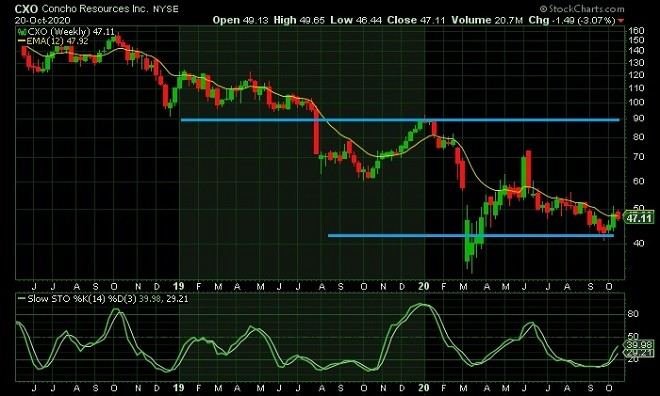
The acquisition news is expected to turn the stock of ConocoPhillips range-bound with a slight bullish bias in the short-term.
Technically, the stock is rising after testing the support at 40. The next major resistance is anticipated only near 90. Additionally, the stochastic oscillator is also ascending. Therefore, we are expecting the stock to rally in the days ahead.
Disclaimer: Any financial trading analysis offered here is our opinion and is not intended as advice or direction for investors. We cannot guarantee the success of any trades made as a consequence of this article, and we encourage traders to incorporate a strong money management strategy to limit losses when they enter the markets. Please use this article as part of your own research before formulating strategies prior to trading.