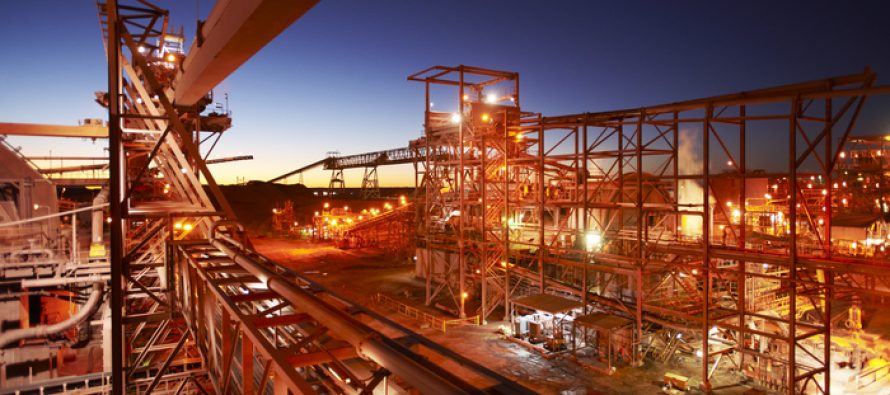
The world’s biggest mining company by market capitalization, BHP Group Ltd. (NYSE: BHP), reported a decline in the production of commodities such as iron ore and petroleum in the quarter ended December 2018. The production loss, valued at $600 million, in the second quarter, was mainly due to interruptions to operations that included an acid plant outage and a train derailment in Australia.
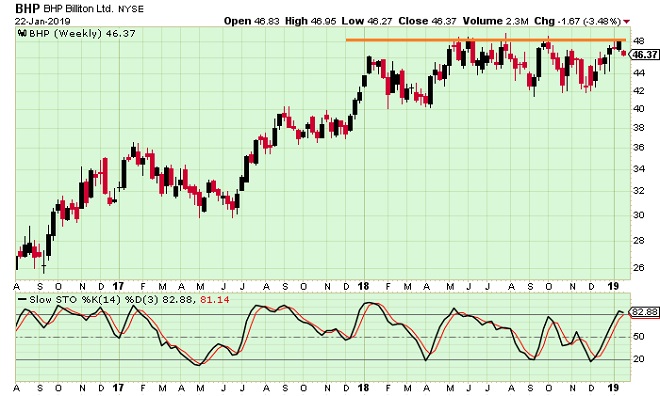
The company has stated that it would revise its guidance while presenting results on February 19th. Following the announcement, the stock ended yesterday’s trading session at $46.37, down 3.48% or $1.67 from the prior close.
BHP to revise guidance due to production disruptions
The Anglo-Australian miner reported iron ore production of 66 metric tons in the quarter ended December 31st, down 8.3% from 72 metric tons in the year-ago period. Unexpected production shutdown caused by an acid plant blackout at the Olympic Dam site in South Australia, the train derailment at Pilbara in Western Australia, and a fire at the electroextraction plant at the Spence copper mine in Chile were the main reasons for disruption in production.
These unexpected events negatively impacted output by 45,000 tons, 25,000 tons and 4 million tons, respectively. As a result, the company posted “lower than expected volumes” for the first half of fiscal 2019.
During the first half of the financial year of 2019, the company realized the price of $55.62 per ton of iron ore, down 2% from the similar period last year and also the January-June 2018 period. Furthermore, the company has so far recorded iron ore production volumes of 119 million tons in FY19.
This implies that BHP will have to mine another 122 million to 131 million tons of iron ore in the January-June 2019 period in order to achieve its production guidance range. BHP, however, maintained its full-year production guidance range of 273mt to 283mt of iron ore from its Western Australia operations.
BHP is the third-largest exporter of iron ore in the world, behind Rio Tinto PLC (RIO) and Vale SA (VALE). Iron-ore shipments by BHP represent nearly one-fifth of seaborne trade in the commodity.
RBC Capital Markets analyst Paul Hissey opined that BHP’s iron ore output was weaker than anticipated, with RBC having predicted 60 million tons.
BHP stated that its efficiency drive, targeted at making its infrastructure and mining network work harder, also saw a reversal by the plant shutdown at its Australian Olympic Dam Copper Mine and fire at Chile-based Spence Mine.
The WA government on Monday said it was in negotiations with BHP following an audit that found underpayment of royalties for more than ten years on iron ore shipments made through its marketing hub in Singapore. BHP also reported a charge of $700 million in the first half, owing to higher income tax payments in Chile and Australia than last year and the settlement of a dispute related to Australian transfer pricing (rules and methods for pricing transactions within and between enterprises under common ownership or control).
In the case of other metals, the copper production of BHP slid 3% to 416,000 tons in the recent quarter, harmed by scheduled maintenance and failures. However, the enterprise upwardly revised its annual copper production forecast to between 1.645 million tons and 1.740 million tons after it failed to arrive at an agreement to sell the Cerro Colorado copper mine in Chile to EMR Capital.
The company also saw a steep decline in quarterly oil production linked to a fall in gas sales. The report stated that the output of oil products in 2Q18 decreased by 8% to 30 mBoE (million barrels of oil equivalent).
The company’s intention to revise guidance due to a decline in the production of iron ore is expected to keep the stock bearish in the short-term.
The price chart indicates that the stock is facing resistance at 48. Furthermore, the stochastics indicator is also in the overbought region. As a result, we can anticipate a decline in the stock price.
Disclaimer: Any financial trading analysis offered here is our opinion and is not intended as advice or direction for investors. We cannot guarantee the success of any trades made as a consequence of this article, and we encourage traders to incorporate a strong money management strategy to limit losses when they enter the markets. Please use this article as part of your own research before formulating strategies prior to trading.