Chipmaker Advanced Micro Devices Inc. (Nasdaq: AMD) announced on Friday that its planned acquisition of specialized IC (integrated chips) manufacturer Xilinx has encountered delays and will be completed only in the first quarter of 2022.
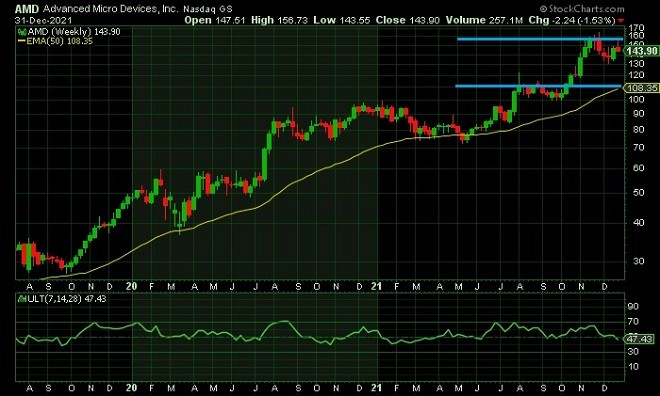
The company had previously expected the acquisition to be completed by the end of 2021. Following the announcement, the stock of AMD closed the last trading session of the year at $143.90, down 0.86% or $1.25 from the previous day’s close.
In October 2020, the Santa Clara, California-based AMD accepted to take over Xilinx in an all-stock deal worth $35 billion. The value of the deal has increased considerably in the last 12 months as the share prices of both companies have surged due to a worldwide chip shortage.
AMX chose to acquire the San Jose, California-based company Xilinx for the latter’s strong foothold in the fast-rising telecom and defense industries.
However, AMD acknowledged that it would not be able to complete the acquisition of Xilinx as planned earlier, and it would happen only in the first quarter of 2022. Xilinx is a manufacturer of sophisticated silicon chips known as field-programmable gate arrays (FPGA), which are mainly utilized in wireless technology, data centers, and the automobile and aviation sectors.
FPGAs, in contrast to traditional semiconductor chips, allow reprogramming after their creation. Due to flexible design, FPGAs can be used for numerous tasks such as quick prototyping. The chips also support sectors, which continue to advance quickly, and corporations do not have the luxury of spending time in designing new processors for particular scenarios. Xilinx’s FPGAs are notable for their role as a critical component in the implementation of 5G networks.
A major reason for AMD to acquire Xilinx is that the former is committed to developing mainstream central processing units (CPUs) and graphics processing units (GPUs) that are utilized in desktop computers, data center servers, and gaming consoles. However, AMD does not have a foothold in the FPGA industry, while its primary competitor Intel Corporation has. Both firms were confident of getting all necessary clearances to complete the transaction by the end of this year, but this has not occurred.
A joint statement released to the press stated that the firms were “continuing to make headway on the regulatory clearances that are necessary to conclude the acquisition.”
The statement reads, “As originally anticipated, we were unable to complete the takeover procedures by the end of 2021, and we currently anticipate the deal to complete in the initial quarter of 2022. Our discussions with authorities are continuing to be fruitful, and we anticipate getting all the necessary permissions.”
The firms also clarified that there have been no new changes to the previously disclosed terms or intentions related to the deal and that they are looking forward to the planned merger to become the semiconductor industry’s leader in adaptive computing.
The postponement in the completion of the acquisition is expected to keep the shares of AMD range-bound in the short term.
The historical price chart indicates that the stock is declining after facing resistance at 150. Additionally, the ultimate oscillator is declining towards the bearish zone. Therefore, we are anticipating the stock to remain in a downtrend in the short term.
Disclaimer: Any financial trading analysis offered here is our opinion and is not intended as advice or direction for investors. We cannot guarantee the success of any trades made as a consequence of this article, and we encourage traders to incorporate a strong money management strategy to limit losses when they enter the markets. Please use this article as part of your own research before formulating strategies prior to trading.