

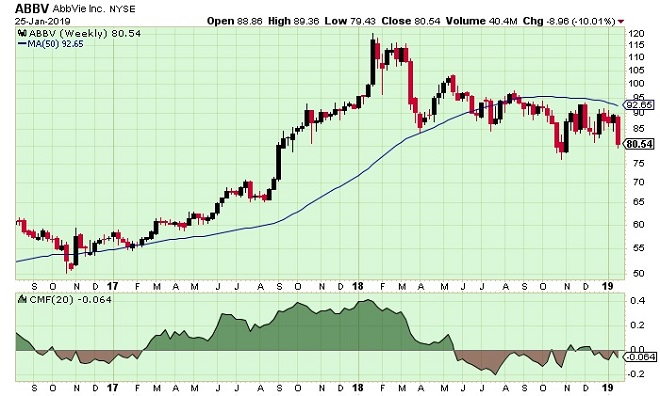
The pharmaceutical company, AbbVie’s (NYSE: ABBV) posted lower than anticipated earnings and revenue in the fourth quarter of 2018. Furthermore, international sales of blockbuster drug Humira reported a decline of 14.8% on a y-o-y basis. Following the weak results, the stock of AbbVie declined 6.22% to close at $80.54. The share price of AbbVie has dropped roughly 7% since the beginning of 2019 and 19% in the past year. The S&P 500 index, in the meanwhile, has appreciated by more than 5%.
Weak Humira sales let down AbbVie
North Chicago, Illinois-based AbbVie reported 4Q18 revenues of $8.31 billion, an increase from $7.74 billion in the similar period last year, but lower than analysts’ revenue estimate of $8.38 billion.
For the quarter ended December 31st, the drugmaker posted a 4Q net loss of $1.83 billion compared with a net profit of $52 million in the comparable quarter last year. On a per-share basis, the net loss for the quarter was $1.23 compared with a net profit of $0.03 per share. Adjusted earnings for the quarter increased to $1.90 per share, from $1.48 per share in the year-ago period. Still, the reported earnings were lower than Wall Street’s earnings estimate of $1.94 per share for the quarter.
Operating loss for Q4 2018 was $2.44 billion, compared with operating profit of $1.78 billion in the year-ago period.
As mentioned earlier, Humira is the flagship product of AbbVie. It is prescribed for the treatment of rheumatoid arthritis, chronic plaque psoriasis, Crohn’s disease, hidradenitis suppurativa, and ulcerative colitis. In 2018, Humira generated roughly $19.94 billion in revenue, up 7.4% on an operational basis. The drug accounted for nearly 61% of AbbVie’s total revenue.
During the recent quarter, Humira recorded a 9.1% increase in US sales to $3.62 billion. In the international market, Humira sales fell due to the rise in competition from biosimilars such as Amgen (AMGN), Novartis (NVS), and Biogen (BIIB). AbbVie allowed the launch of biosimilars (copies) of Humira in Europe. Biosimilars are nearly identical copies of biologic drugs.
Notably, no biosimilars will be available in the US until 2023 as per the current agreements. International sales of Humira declined to $1.30 billion. Overall, Humira generated sales of $4.92 billion, representing a small growth of 1.4% on a y-o-y basis. The FactSet analysts anticipated revenue of $5.02 billion for Humira.
Commenting on the decline, the AbbVie said: “Internationally, Humira sales declined 14.8% operationally due to direct biosimilar competition in certain international markets.”
Other notable drugs produced by the company include Imbruvica (cancer), Mavyret and Viekira (both for hepatitis C virus (HCV) treatment). Imbruvica is sold in partnership with Johnson & Johnson (JnJ). AbbVie’s other leukemia drug, named Venclexta, generated sales of about $124 million.
During the fourth-quarter, Imbruvica revenues jumped 42% y-o-y to $1 billion. Likewise, robust sales of Mavyret enabled HCV to generate sales of $862 million, more than twice the amount produced in the comparable quarter of 2017. In the US, the drug recorded growth of 92%, while international sales rose 56.6%.
The company expects FY19 earnings to be between $8.65 and $8.75 per share. The Zacks Consensus Estimate is currently $8.68 per share on revenues of $33.51 billion. Weak 4Q18 results are expected to keep the stock bearish in the short-term.
The price chart shows that the stock is struggling to cross above its 50-day moving average. Furthermore, the Chaikin money flow indicator is in the negative region. As a result, we anticipate the stock to remain weak in the short-term.
Disclaimer: Any financial trading analysis offered here is our opinion and is not intended as advice or direction for investors. We cannot guarantee the success of any trades made as a consequence of this article, and we encourage traders to incorporate a strong money management strategy to limit losses when they enter the markets. Please use this article as part of your own research before formulating strategies prior to trading.


