In the third week of October, the shares of Alphabet (NASDAQ: GOOGL) recorded a 12-month high of $839. However, the stock was unable to consolidate at that level. In fact, to the surprise of market participants, the stock started declining after the company reported fiscal 2016 third-quarter results that beat the analysts’ estimates. The analysts opined that the double-digit decline in the cost-per-click and the increasing competition from the social media giant Facebook had created a dampened view of the stock and ultimately triggered a wave of selling. At the current price level of about $779.98, we believe that a long position can be taken due to the following reasons.
The Mountain View, California-based parent company of Google reported fiscal 2016 third-quarter GAAP net income of $5.061 billion or $7.25 per share on revenues of $22.451 billion, compared to GAAP net income of $3.979 billion or $5.73 per share on revenues of $18.675 billion in the similar period last year.
Excluding charges, the world’s number one search engine provider announced an increase in the non-GAAP net income to $6.326 billion or $9.06 per share, from non-GAAP net income of $5.102 billion or $7.35 per share in the corresponding quarter last year. The Wall Street analysts anticipated Alphabet to post earnings of $8.63 per share on revenues of $22.05 billion.
The revenues from the sales of websites grew 23% to $16.09 billion and topped the Street’s estimates of $15.79 billion. The company reported advertising revenue of $19.8 billion, up 18% from $16.8 billion last year. Advertising revenues account for nearly 90% of Alphabet’s revenue.
According to eMarketer, in 2016, the company is expected to receive nearly 59% of its global advertisement revenue from mobile internet ads. In 2015, Alphabet earned about 45.8% of its total revenue from mobile advertisements. In an attempt to increase revenues from mobile ads, the company has launched an in-house designed Android phone named Pixel.
A matter of concern for the investors is the 11% decline in the aggregate cost-per-click during the third quarter. Separately, the cost-per-click fell 13% on Google websites and 14% on Google network members’ websites.
However, it should be noted that the aggregate paid clicks increased by 33% y-o-y in Q3 2016. In the case of Google websites, the paid clicks increased 42% on a y-o-y basis. Thus, as of now, it should not be a matter of concern and a long position can be taken when the stock dips.
The $7 billion Class C share repurchase program is also expected to boost the share price. Thus, fundamentally, the stock is expected to remain bullish in the current quarter.
The stock has started moving up after testing the major support at 750. The stochastic oscillator, with a reading of about 10, indicates a bullish reversal. Thus, a long position would be ideal at this point in time.
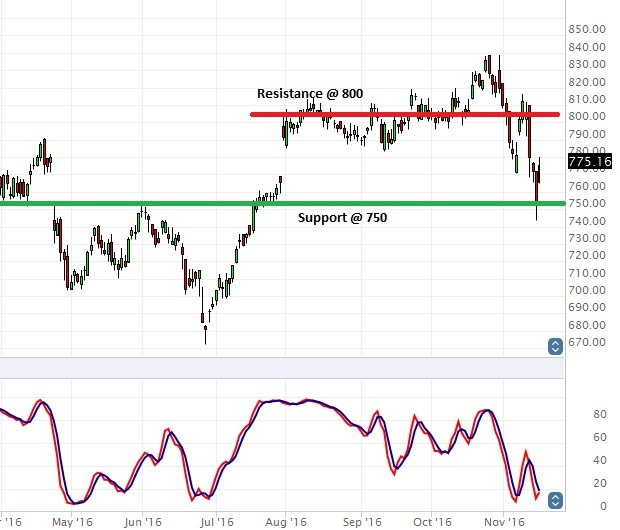
To speculate on an uptrend in the stock, a binary trader can ponder at the possibility of trading a one-touch call option. It would be better if the strike price of the call option is less than $800. With an expiry date around the 15th of December, the trader can hope to generate considerable returns in a short span of time.
Disclaimer: Any financial trading analysis offered here is our opinion and is not intended as advice or direction for investors. We cannot guarantee the success of any trades made as a consequence of this article, and we encourage traders to incorporate a strong money management strategy to limit losses when they enter the markets. Please use this article as part of your own research before formulating strategies prior to trading.