For the most part of October, the Japanese Yen remained strong against the currencies of developed countries such as the US and Canada. The nervousness caused by the pre-election rhetoric of Donald Trump forced investors to look for safe-haven assets such as the Japanese Yen. On the contrary, economic contraction in the second quarter and weak crude price took a toll on the Canadian dollar. However, things changed drastically in the second half of November.
The soothing message of Trump eased investors’ concern. This led to the unwinding of long positions in the Yen. The 0.3% GDP growth in November and the probability of a crude oil production cut by the OPEC members strengthened the Canadian dollar. Ultimately, the CADJPY pair rose to a high of 86.01, from 74.80 a month ago. However, the Yen is now poised to strengthen against the Canadian dollar once again due to the reasons given below.
The measures taken by the Bank of Japan and the Japanese government to boost trade are showing signs of success. The Japanese economy expanded 0.5% q-o-q in the third quarter of 2016. The Q3 GDP growth was more than double the 0.2% growth recorded in the second quarter of 2016 and also higher than the 0.2% growth anticipated by the analysts. The jobless rate in October 2016 was 3% and in line with the analysts’ estimates. More importantly, in October 2016, for the first time in eight months, consumer prices increased by 0.1% y-o-y. Thus, considering the positive economic data, the BoJ may not contemplate further easing measures. Furthermore, the analysts believe that the Trump rally is overblown and the US dollar would see a correction soon. All these factors would certainly strengthen the Yen in the short-term.
As 2017 approaches, the market is expected to see increased volatility. This is particularly true in the case of the Canadian dollar. Trump, during his election campaign, had made it clear that he would renegotiate the NAFTA agreement with Canada and Mexico. Furthermore, the skeptics of OPEC production cuts still argue that similar agreements have failed in the past. Thus, the current strength of the Canadian dollar will not last for long unless the production cut gets materialized and still there is a month left for that to happen. Thus, the CADJPY pair is expected to decline in the coming days.
The price chart indicates the existence of major resistance for the CADJPY pair at 86.10. The RSI indicator has entered into the overbought territory. Thus, it is prudent to go short in the currency pair at this point in time. The entry price can be near 85.40. With a stop loss and take profit order at 87 and 82 respectively, a trader can look forward to the decline of the CADJPY pair.
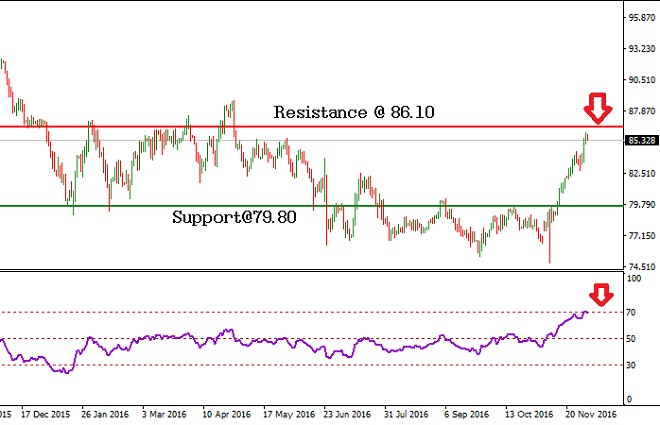
A low or below contract, which is an equivalent of the put option, should be chosen for investment by a binary options trader. The purchase can be made as long as the price trades near the 85.40 levels. The trader can choose any expiry date which falls within one week from the time of investment.
Disclaimer: Any financial trading analysis offered here is our opinion and is not intended as advice or direction for investors. We cannot guarantee the success of any trades made as a consequence of this article, and we encourage traders to incorporate a strong money management strategy to limit losses when they enter the markets. Please use this article as part of your own research before formulating strategies prior to trading.