

Since mid-March, the USDJPY pair has been on an uptrend. From a low of 104.63, the currency pair had gained more than 500 pips to reach 109.75 levels. The interest rate differentials and the Fed rate hike in March sparked a rally in the USDJPY. We anticipate the greenback to rise further in the days ahead due to the reasons given below.
The Japanese yen is weakening due to two main reasons. Firstly, the policy divergence between central banks of Japan and the USA has encouraged traders to prefer the greenback over the yen. Secondly, Trump’s decision to pull the US out of the nuclear deal with Iran sparked a crude oil rally. Again, this has turned commodity currencies more attractive to traders.
The bearish sentiment towards the yen is also fuelled by a decline in business confidence. Yesterday, Japan’s Cabinet Office announced that the Business Conditions Index slipped to 105.0 in March, from 105.90 in February, and slightly below economists estimate of 105.20.
In the US, the Treasury will access the market for around $35 billion of 3-yr bonds this week. Furthermore, the Treasury will also tap the market for $25 billion of 10-year bonds and $17 billion of 30-year debt. Notably, the money that is going to be raised is higher than what it was during the same time last quarter. Analysts expect the trend to continue in the foreseen future. This has already driven the 10-year bond yield to a multi-year high last month. Ironically, the yields are turning lower in other countries.
Crude oil has appreciated by over 60% in the past year and it is expected to push inflation figures higher. Rising commodity prices generally permeate across the entire economy and increase inflation. Therefore, the combination of robust US economic growth, rising inflation, and weak growth outside the US has turned the greenback attractive than its peers. So, fundamentally, we can expect the USDJPY pair to forge higher in the week ahead.
The USDJPY pair is forming a rounding bottom pattern, as shown in the image below. The bullishness is also confirmed by the rising accumulation indicator. Therefore, we are expecting the USDJPY pair to undergo a strong uptrend.
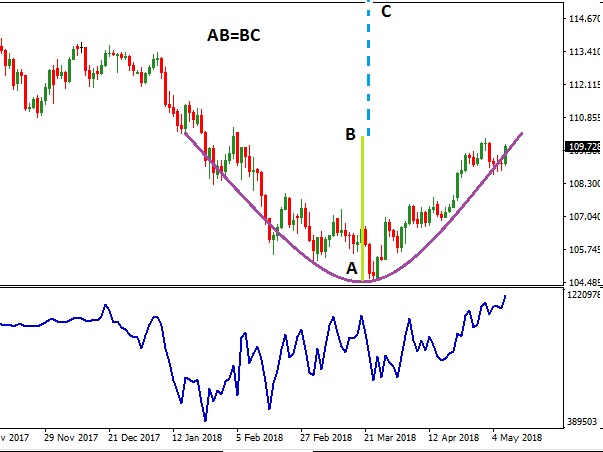
In the spot Forex market, we may go long in the USDJPY pair near 109.70, with a stop-loss order below 108.40. Simultaneously, we would place an order to book profit near 113.40.
As the pattern is highly reliable, we may also use our surplus funds to purchase a call option contract from a dependable binary broker. At the time of purchasing an option contract, having an expiry date on or around May 18, we will make sure the USDJPY pair trades near 109.70.
Disclaimer: Any financial trading analysis offered here is our opinion and is not intended as advice or direction for investors. We cannot guarantee the success of any trades made as a consequence of this article, and we encourage traders to incorporate a strong money management strategy to limit losses when they enter the markets. Please use this article as part of your own research before formulating strategies prior to trading.


