Diversified industrial conglomerate General Electric Company (NYSE: GE) reported a swing to a net loss in the fiscal 2017 fourth-quarter, compared to a net profit in the similar period last year. The losses were driven by investment contracts, insurance losses, and insurance annuity benefits. Both earnings and revenues missed analysts’ estimates. However, the company issued an upbeat FY18 outlook. Still, we anticipate the stock to decline due to the reasons given below.
The Boston, Massachusetts-based company reported 4Q17 revenue of $31.402 billion, down 5% from $33.09 billion in the year-ago period. The Street analysts had expected GE to report revenues of $34.06 billion.
During the quarter ended December 2017, net earnings attributable to GE shareholders is $9.826 billion, or 1.13 billion, compared to a net profit of $3.486 billion, or $0.39 per share in the prior-year similar period.
Last week, GE had announced that it would take a $6.2 billion charge in the fourth quarter. The company also revealed that it will set aside $15 billion over seven years to pay for obligations held by its finance division. The earnings report indicated that GE had taken a charge of $10.260 billion on investment contracts, insurance losses, and insurance annuity benefits in the recent quarter. In the same period last year, GE took a charge of only $696 million. Overall, costs and expenses increased 46% y-o-y to $44.004 billion.
Excluding charges, GE reported non-GAAP earnings of $2.325 billion, or $0.27 per share, down from $4.081 billion, or $0.46 per share, in the fourth quarter of 2016. The Thomson Reuters Consensus estimates called for earnings of $0.29 per share.
Barring the Renewable Energy, and Oil & Gas division, all other segments performed poorly. The Power segment recorded a 15% decline in revenues to $9.421 billion. The Aviation segment posted an almost flat revenue of $7.222 billion, compared to last year. The Healthcare division reported revenues of $5.40 billion, down 6% on a y-o-y basis. The Transportation division saw its Q4 revenues decline 20% y-o-y to $993 million. The Renewable Energy segment reported a 15% growth in revenue to $2.875 billion. The Oil & Gas division recorded revenues of $5.756 billion, an increase of 69% from the previous year.
GE stated that its cash performance in the fourth quarter was better than expected. The company saved $1.70 billion in structural costs in 2017, above the targeted saving of $1 billion for 2017. GE plans to save another $2 billion in 2018.
GE said it expects adjusted earnings of between $1 and $1.07 per share in fiscal 2018. The company is also planning to announce a new board with its 2018 proxy.
The rally seen yesterday was mainly driven by the upbeat outlook. The market expects GE to split by this spring. None of the top investment research firms hold a bullish view on GE. Considering the poor performance of most of its divisions, a swing to a net loss, and headwinds faced by the company, we expect the stock to remain in a downtrend.
Technically, the stock is expected to face heavy resistance at 17.75 levels. Furthermore, the MACD indicator is moving below the zero reading. Therefore, we are expecting the stock to decline further.
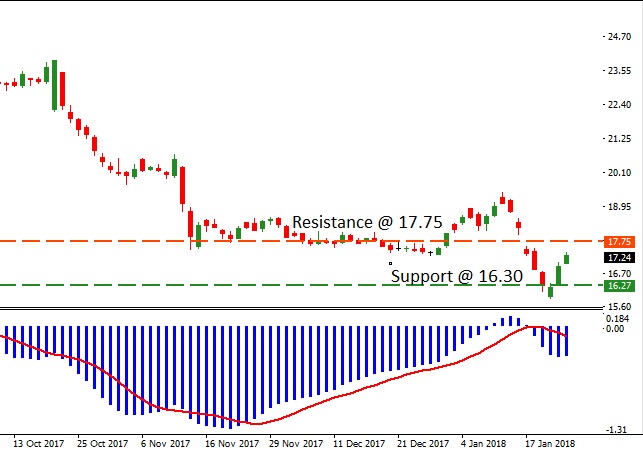
To capitalize on the probable downtrend, we are considering the possibility of investing in a put option. While choosing a put option contract, we will make sure that the option remains active until February 3rd. Further, the stock of GE should be trading near $17.0 in the cash market.
Disclaimer: Any financial trading analysis offered here is our opinion and is not intended as advice or direction for investors. We cannot guarantee the success of any trades made as a consequence of this article, and we encourage traders to incorporate a strong money management strategy to limit losses when they enter the markets. Please use this article as part of your own research before formulating strategies prior to trading.