
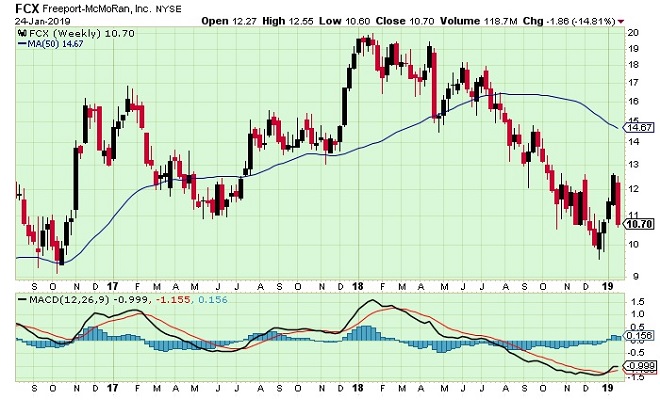
The stock of the world’s second-largest copper mine, Freeport-McMoRan (NYSE: FCX), reported lower-than-anticipated fourth-quarter profits due to declining prices of copper. The company also issued an unimpressive 1Q19 production outlook. Following the release of 4Q18 results, the stock dropped 13.08% to close at $10.70. Notably, before the results were declared yesterday, Freeport-McMoRan shares had gained roughly 19.4% since the beginning of 2019, compared with the S&P 500’s gain of 5.3%.
Freeport-McMoRan reports big earnings miss
Phoenix-based Freeport reported fiscal 2018 fourth-quarter revenues of $3.68 billion, down 27% from $5.04 billion posted in the similar period last year. The revenues also missed the Zacks Consensus Estimate by 4.28%. Freeport has surpassed Zacks revenue estimate thrice over the previous four quarters.
For the quarter ended December 31st, the copper, gold, and molybdenum miner reported a net income of $140 million, or $0.09 per share. This compares with $1.04 billion or $0.71 per share in the similar period last year. Excluding items, Freeport-McMoran posted adjusted earnings of $161 million or $0.11 per share. On average, analysts polled by Thomson Reuters anticipated earnings of $0.18 per share. In the previous quarter, the company posted $0.35 per share and exceeded analysts’ estimates of $0.33 per share.
After nearly a year-long negotiation, the company surrendered majority ownership of Grasberg, the second-largest copper mine in the world, to the Indonesian government even though it will continue to run the project.
During the quarter, the company sold 785 million pounds of copper, 24 million pounds of molybdenum, and 266 thousand ounces of gold. The company reported consolidated production of 841 million pounds of copper, down 17% y-o-y, and 334 thousand ounces of gold. Still, the sales were lower because of the timing of shipments.
The average realized price in 4Q18 was $2.75 per pound for copper, down 14% on a y-o-y basis. Similarly, average realized prices for molybdenum and gold were $12.75 per pound and $1,255 per ounce, respectively.
Commenting on the results, Chief Executive, Richard Adkerson, said: “Despite recent market uncertainty, we remain confident in the fundamentals and long-term outlook for copper.”
Demand for copper has declined in the past year on concerns about a global economic slowdown and the ongoing trade spat between the United States and China.
Freeport envisions the US, where over 40% of its reserves exist, as the primary growth region. The company intends to spend $850 million to establish a new copper mine next year.
In the current quarter, the company expects sales volumes of 800 million pounds of copper, 255,000 ounces of gold, and 24 million pounds of molybdenum. For FY19, Freeport anticipates sales volumes of roughly 3.3 billion pounds of copper, 0.80 million ounces of gold, and 94 million pounds of molybdenum.
For FY19, Freeport expects capital expenditures to be about $2.40 billion, including $1.50 billion for several mining projects such as Arizona’s Lone Star oxide project and underground development work in the Grasberg mine.
Operating cash flows are anticipated to be approximately $1.8 billion for FY19. That was based on the average price assumption of $2.75 per pound for copper, $12.00 per pound for molybdenum, and $1,300 per ounce for gold.
FCX declared a quarterly cash dividend of $0.05 per share on December 19th, 2018, payable to shareholders on February 1st, 2019.
Considering the weak earnings and unimpressive production forecast, fundamentally, the stock is expected to remain weak in the days to come.
The price chart indicates that the stock is trading below its 50-day moving average. Furthermore, the MACD indicator is still in the negative region. As a result, we can expect the stock to remain bearish in the short-term.
Disclaimer: Any financial trading analysis offered here is our opinion and is not intended as advice or direction for investors. We cannot guarantee the success of any trades made as a consequence of this article, and we encourage traders to incorporate a strong money management strategy to limit losses when they enter the markets. Please use this article as part of your own research before formulating strategies prior to trading.