
The Japanese yen strengthened against its peers in quiet trading yesterday. As there were no significant economic releases or essential events, a sideways movement was seen in the markets. Fading anticipations for a widening of the US-Japan interest rate differentials also aided the USD/JPY sell-off. Another major development that encouraged traders to shy away from the greenback was that the US Justice Department charged China-based Huawei Technologies Co with fraud, escalating the US-Sino trade tensions.
BoJ’s outlook, increasing US-China trade tensions strengthen the yen
Yesterday, the minutes of the December monetary policy meeting released by the Bank of Japan offered minimal insights into the economy. Regarding the economic outlook, the minutes said: “members concurred that it was likely to continue its moderate expansion.”
While highlighting the hurdles the economy may face in the months ahead, the minutes also pointed out the weakness in exports to China. The meeting minutes also revealed that the Japanese “firms held cautious views, mainly against the background of the prolonged US-China trade friction.”
Regarding inflation, the notes said: “The year-on-year rate of change in the CPI continued to show relatively weak developments compared to the economic expansion and the labor market tightening.”
Still, the outlook for future developments was somewhat optimistic: “In terms of the outlook for prices, most members shared the view that the year-on-year rate of change in the CPI was likely to increase gradually toward 2 percent, mainly on the back of the output gap remaining positive and medium- to long-term inflation expectations rising.”
Later yesterday, the Bank of Japan released a Monthly Report on the Services Producer Price Index (SPPI) which showed a 1.1% y-o-y increase in December. In the previous month, the Monthly Report on the Services Producer Price Index rose 1.2%. Economists had anticipated the rate of growth to remain unchanged in December. Monthly Report on the Services Producer Price Index is a leading indicator of consumer inflation.
Optimistic outlook about Japan’s economy, as revealed by the BoJ meeting minutes and relatively stable SPPI growth triggered USD/JPY sell-off. According to traders, the greenback was also bogged down by offloading of dollars by the Japanese exporters.
There were also reports that the Fed is considering a premature end to its balance sheet reduction. An unnamed executive of a major securities firm opined that the news “helped diminish market expectations for a widening in Japan-U.S. interest rate gaps, and this made the dollar vulnerable to selling versus the yen.”
In the meanwhile, the Justice Department charged China’s Huawei Technologies Co Ltd, its chief financial officer, and two other executives with bank and wire fraud for breaching sanctions against Iran. Investors are concerned that the charges could further muddle important trade negotiations scheduled to begin today. Notably, China’s Vice Premier, Liu He, is expected to meet the US Trade Representative Robert Lighthizer.
Commenting on the impact of trade tensions on the demand for risky assets, Nick Twidale, chief operating officer at Rakuten Securities, said “There is a much lesser chance now that we get anything positive out of these trade negotiations. This is likely to be bad for risky assets such as stocks, and we expect the dollar/yen and Australian dollar to be under pressure.”
Currency traders will also be closely looking at the Federal Open Market Committee policy meeting that is about to begin later today when Chairman Jerome Powell is broadly anticipated to acknowledge increasing risks to the US due to the global economic slowdown. Therefore, we can expect the USD/JPY pair to remain weak in the short-term.
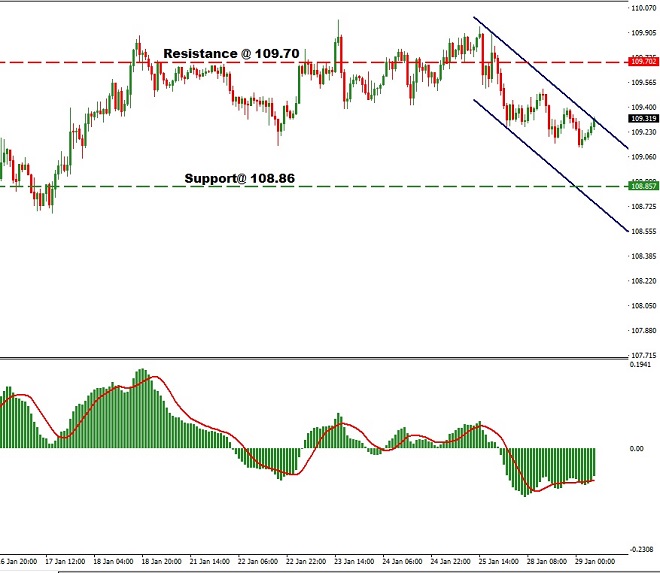
Technically, the currency pair is facing heavy resistance at 109.70. Additionally, the MACD indicator is also in the negative region. The next major support is expected only at 108.80 levels. As a result, we can expect the currency pair to remain weak in the short-term.
Disclaimer: Any financial trading analysis offered here is our opinion and is not intended as advice or direction for investors. We cannot guarantee the success of any trades made as a consequence of this article, and we encourage traders to incorporate a strong money management strategy to limit losses when they enter the markets. Please use this article as part of your own research before formulating strategies prior to trading.