Yesterday, the Australian Bureau of Statistics announced a 0.6% rise in the Wage Price Index in the June quarter, from the earlier quarter on a seasonally adjusted basis. The actual increase met analysts’ expectations and surpassed the previous quarter’s 0.5% rate of increase. However, poor employment change data and a fall in the price of commodities are not expected to support the current rally in the Aussie.
Australia employment change
Earlier today, the Australian Bureau of Statistics (ABS) published the country’s most recent unemployment rate and employment change figures for July. The seasonally-adjusted unemployment rate was 5.3% – a notch better than analysts’ expectation of 5.4%. However, the month-over-month employment change data missed economists’ expectations of +15,000 job additions. In fact, the Australian economy lost 4,000 jobs in July, and labor participation decreased to 65.5%.
Job losses are reflected in the bond market, with gains in the price of long-term bonds. The yield rate, which is inversely proportional to the bond prices, fell 1 basis point to 2.563% for the 10-year bond. The yield on a 30-year note also declined 1 basis point to 3.06%.
Iron ore price decline
The price of iron ore fell 4% in the Chinese futures market to around $68 per ton for a 62% Fe grade. Furthermore, the Australian government stated that it expects iron ore prices to average $51.50 per ton this year, down 20% from 2017, mainly due to an increase in global supply and a decline in demand from major Chinese importers. This is a result of the country’s stringent pollution control rules resulting in a shutdown of mills with outdated technology.
US retail sales
The Commerce Department stated that retail sales grew 0.5% in July, which is a great deal higher than economist expectations of a 0.1% increase. The report also indicated that the June retail sales growth of 0.5% was downwardly revised to 0.2%. Robust sales of motor vehicles and parts contributed to the strong rise in retail sales. Excluding the sales of vehicles, retail sales grew 0.6% in July, up from a 0.2% increase in the earlier month. Devoid of auto sales figures, analysts had expected retail sales growth of just 0.3%.
Crude oil inventory
Finally, the price of crude oil fell more than 3% to $65.01 per barrel, after the US crude inventories increased unexpectedly last week. While the market was expecting crude to decrease by 2.6 million barrels, inventories rose by 6.8 million barrels. The information was published by the Energy Information Administration.
The US dollar has therefore had an inverse relationship with the price of crude oil, and strong retail sales data is expected to keep it bullish. Therefore, fundamental traders are in mind to support the decline of the AUDUSD pair.
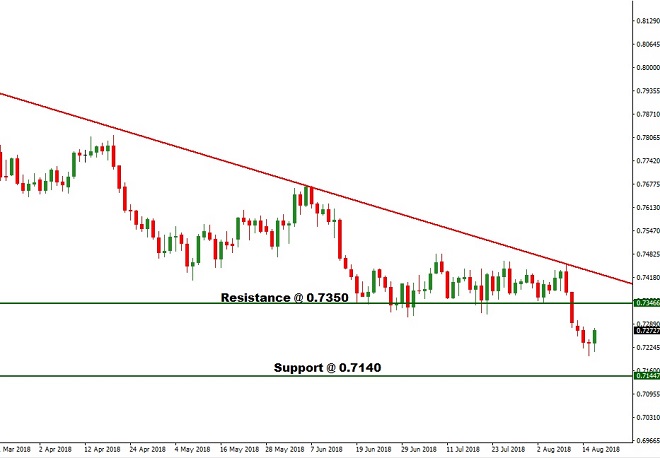
Technically, the stock has broken a descending triangle pattern (as shown in the chart above). The next major support exists only at 0.7140. So, a continuation of the current downtrend can be expected.
Disclaimer: Any financial trading analysis offered here is our opinion and is not intended as advice or direction for investors. We cannot guarantee the success of any trades made as a consequence of this article, and we encourage traders to incorporate a strong money management strategy to limit losses when they enter the markets. Please use this article as part of your own research before formulating strategies prior to trading.