The pound rose against the greenback following the release of higher-than-anticipated US unemployment claims data. The pound’s uptrend was also stoked up by the hawkish statement of the BoE’s Governor Andrew Bailey. Overall, the GBP/USD pair rallied from a low of 1.2060 to a high of 1.2165 in the past 24 hours.
The UK RICS (residential market survey) price balance, reflecting the difference between the proportion of poll participants expecting increases and decreases in housing prices, fell to -47 in January from -42 in December. Economists had anticipated the index reading at -45%. The reported reading reflects the lowest level since April 2009, as increases in borrowing expenses and economic unpredictability slowed down buyer demand. January’s data also represented the fourth consecutive month of negative readings.
Simon Rubinsohn, the chief economist at RICS, pointed out that the market’s sentiment remains negative, but expressed reservations about a further decline in housing prices as the Bank of England and the rest of the institutions’ macroeconomic predictions are currently envisioning a less brutal economic scenario in 2023.
A week before, the BoE stated that the British economy would probably go into recession from the beginning of this year to 2024, a narrower time frame compared to earlier forecasts.
In the European trading session, prominent members of the Bank of England’s Monetary Policy Committee (MPC) signaled another rate hike in March, citing UK inflation risks.
Specifically, the central bank’s Governor Andrew Bailey stated, “We anticipate a sharp decline in inflation in 2023 […]. Baseline factors will have a powerfully negative impact on the UK’s CPI this year. We are worried about the continuance of inflation, which is the reason I have advocated for raising interest rates.”
Bailey believes that inflation has hit its peak and has started declining, but prefers to see further empirical data in support of the argument. Until that happens, Bailey does not wish to exit the rate hike cycle.
On Wednesday, the report published by the UK’s National Institute of Economic and Social Research (NIESR) indicated that the country will probably avoid an extended recession in 2023. The institution’s recent projections also indicate that inflationary pressure will still remain higher than 3% until the end of 2024. In fact, NIESR expects inflation to reach the BoE’s 2% target only by the third quarter of 2025.
The Bank of England now expects the UK economy to contract by 0.70% in 2023 through the end of 1Q 2024.
According to the US Department of Labor, the country’s first-time unemployment claims rose to 196,000 in the week ended February 4 from 183,000 in the previous week. Economists had anticipated jobless claims of 191,000. The reported reading reflects the first increase in six weeks.
The four-week moving average was 189,250, down 2,500 from the earlier week’s average of 191,750.
The hawkish comment by the BoE policy committee and the increase in US unemployment claims are expected to keep the pound slightly bullish in the short term.
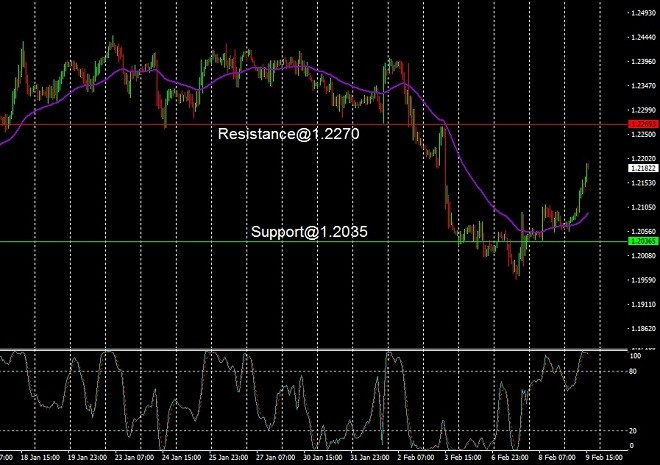
The historical chart indicates that the GBP/USD pair is rising after testing the support at 1.2035. The next resistance is anticipated only near 1.2270. Additionally, the GBP/USD pair is trading above its 50-day moving average while the stochastic indicator is in the bullish zone. Therefore, we anticipate the currency pair to remain in an uptrend in the days ahead.
Disclaimer: Any financial trading analysis offered here is our opinion and is not intended as advice or direction for investors. We cannot guarantee the success of any trades made as a consequence of this article, and we encourage traders to incorporate a strong money management strategy to limit losses when they enter the markets. Please use this article as part of your own research before formulating strategies prior to trading.