The greenback gained against the Canadian dollar yesterday despite the report of a wider than anticipated trade deficit in February. Even the upbeat Richard Ivey PMI data from Canada was not adequate to spark speculative buying of the loonie.
The market is currently driven by optimism about the US economic rebound in the months ahead. In the last 24 hours, the USD/CAD pair rallied from a low of 1.2560 to a high of 1.2635.
Data published by Statistics Canada indicates that the country’s trade surplus declined slightly to C$1 billion in February, from C$1.20 billion in January, and missed the C$1.30 billion remnants anticipated by economists.
Notably, for the first time since the final part of 2016, the country has recorded a trade surplus for two successive months.
Total exports declined by 2.7% to C$49.90 billion in February, following a jump of 8.2% in the prior month. The reported figure is 4.1% higher than the pre-pandemic February 2020 level.
The decline was led by10.9% drop in the exports of metal and non-metallic mineral products. Exports of aircraft and other transportation machinery and parts declined 20.3% in February, primarily due to a 30.2% drop in exports of aircraft.
Likewise, exports of metal ores and non-metallic minerals fell by 26.7% in February, primarily due to a 39.8% decrease in the export of iron ores. Shipment of energy products partly nullified the overall decline, increasing 18.3% to C$9.50 billion, the highest figure since December 2019.
Total imports fell by 2.4% in February to C$48.80 billion, reflecting the lowest level since August 2020. Following a 22.8% rise in January, imports of energy products declined by 21.4% in February.
The overall decrease was partially mitigated by a 29.1% rise in aircraft imports and other transportation equipment and parts.
Exports of motor vehicles and parts fell by 10.2% to C$6.10 billion, reflecting the second-largest decline in the exported product categories in February.
An 11.5% drop led to the decline in passenger cars’ exports and light trucks as manufacturing plants in Canada had to slow down production due to scarcity of semiconductor parts. Exports of engines and parts reported a decrease of 7.9% in February.
Imports of motor vehicles and parts declined 7.85 to C$8 billion, the most significant drop among import product categories in February. Imports of engines and parts decreased 14.4%, mirroring the scarcity in the supply of semiconductor chips. Imports of passenger cars and light trucks reported a decline of 4.6% due to the semiconductor chip supply issue.
After five consecutive months of growth, exports to countries other than the US fell by 11.7% to C$12.50 billion in February. Canada’s trade deficit with countries other than the US widened to $5.70 billion in February, from C$4.70 billion in January.
The Richard Ivey PMI (purchasing managers’ index) increased to 72.90 in March, from 60 in the earlier month, surpassing the reading of 62.0 anticipated by economists.
A reading above 50 indicates industry expansion and vice-versa. In March 2020, the task was 26, reflecting the impact of the COVID-19 pandemic.
The latest reading was the highest since March 2011, reflecting a robust improvement in the Canadian economic activity.
The employment index rose to 62.70 in March, from 54 in February. Inventories index increased to 61.70 in March, from 57.80 in February.
In the meantime, deliveries slowed down, with the index inching lower to 39.60 in March from 38.60 in February. The prices index decreased to 75.10 in March, from 80.20 in February.
In the US, according to the Bureau of Economic Analysis, the trade deficit widened to $71.10 billion in February, from C$67.80 billion in January. The reported reading was worse than the $70.20 billion trade deficit anticipated by economists.
Exports declined by $5 billion m-o-m to $187.30 billion in February. Specifically, exports of goods fell $4.80 billion to $131.10 billion in February. Capital goods exports recorded a decline of $2.50 billion.
Exports of services dropped $0.20 billion to $56.10 billion in February. Travel services posted a drop of $0.10 billion.
Import fell by $1.70 billion m-o-m to $258.30 billion in February. Goods imports recorded a decrease of $2 billion to $219.10 billion.
Automotive vehicles, parts, and engines posted a drop of $3.40 billion. Consumer goods fell by $2.70 billion. On the contrary, industrial supplies and materials imports recorded a rise of $3.50 billion.
Imports of services rose by $0.30 billion to $39.20 billion in February. Transport rose by $0.20 billion. Insurance services reported an increase of $0.10 billion.
The rise in the goods and services deficit mirrored an increase in the goods deficit by $2.80 billion to $88 billion and a drop in the services surplus by $0.50 billion to $16.90 billion.
On a year-to-date basis, the goods and services deficit rose by $56.50 billion (68.60%), from the comparable period last year. Exports fell by $36.20 billion (8.7%), while imports rose by $20.30 billion (or 4.10%).
For the three months ended February, the average goods and services deficit rose by $0.70 billion to $68.60 billion.
According to the data published by the US Energy Information Administration, crude oil inventories declined by 3.50 million barrels in the week ended April 3, 2020, following a drop of 0.90 million barrels in the last week.
Economists had anticipated a decrease of 2 million barrels for the reported period.
The US and Canada’s mixed economic data is expected to keep the USD/CAD pair range-bound with a slight bullish bias.
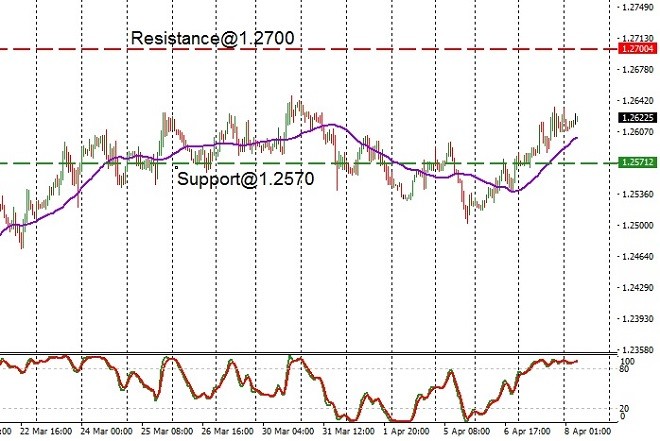
The historical price chart indicates that the USD/CAD pair has bounced off the support at 1.2570. The next resistance is anticipated only near 1.2700. Additionally, the currency pair is trading above the 50-day moving average, while the stochastics indicator is in the bullish zone. Therefore, we are anticipating the currency pair to remain in an uptrend for the next few days.
Disclaimer: Any financial trading analysis offered here is our opinion and is not intended as advice or direction for investors. We cannot guarantee the success of any trades made as a consequence of this article, and we encourage traders to incorporate a strong money management strategy to limit losses when they enter the markets. Please use this article as part of your own research before formulating strategies prior to trading.