
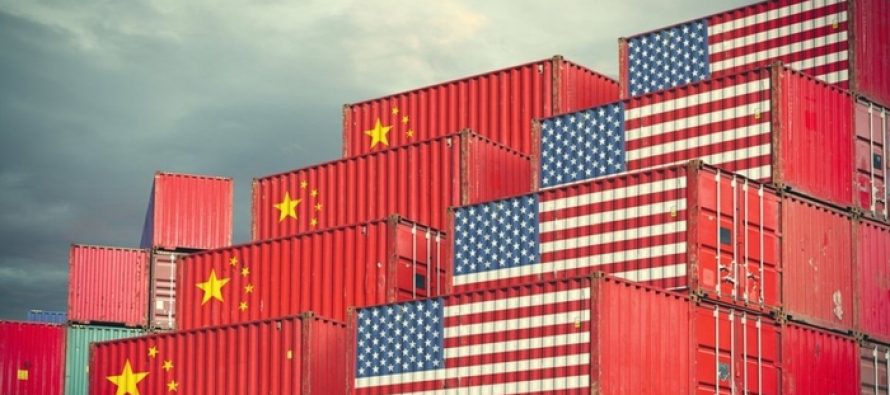
The United States has abstained from labeling China a “currency manipulator,” a decision that could assist in defusing heightening anxiety over trade between the two countries. In the past, President Trump has accused China of deliberately keeping its currency frail to ensure it remains competitive in exports. There was speculation that the US Treasury would officially announce the claim, however, that did not happen. But the Treasury stated that China’s policies continue to remain a matter of concern.
US-China Trade war and the yuan devaluation
In its Semi-Annual Report to Congress on International Economic and Exchange Rate Policies, the Treasury Department decided that none of the key trading partners of the US fulfilled the rules of currency manipulation during the year ending June 2018.
Beijing’s clouded decisions and decline of the yuan acted as setbacks to accomplishing a “more balanced trade,” Treasury Secretary Steven Mnuchin opined in a twice a year document on the foreign exchange policies of the United States’ key trading partners.
The Treasury did not come across any evidence of Chinese intervention to weaken the yuan’s value. By keeping Beijing and five major US trading partners on notice, the Treasury again abstained from heightening a tussle over the Chinese yuan as President Donald Trump had previously vowed to do during the Presidential campaign. The last Treasury report in April 2018 has made almost similar conclusions. Still, China will stay on the list of nations the US monitors, along with Japan, India, South Korea, Germany, and Switzerland.
There are three criteria that should be met for the US to designate a country as a currency manipulator. The three assessment criteria are:
- A significant bilateral trade surplus with the United States is one that is at least $20 billion,
- A material current account surplus is one that is at least 3 percent of gross domestic product (GDP) and,
- Persistent, one-sided intervention occurs when net purchases of foreign currency are conducted repeatedly and total at least 2 percent of an economy’s GDP over a 12-month period.
To get listed, China met one criterion, i.e., having a significant bilateral trade surplus. But the country did not have an account surplus greater than 3% of GDP and proof of a “persistent, one-sided” interference in the Forex market.
While releasing the report, Mnuchin said: “Of particular concern is China’s lack of currency transparency and the recent weakness in its currency.”
He further stated: “These pose major challenges to achieving fairer and more balanced trade and we will continue to monitor and review China’s currency practices, including through ongoing discussions with the People’s Bank of China.”
Notably, for over 20 years, the US has not labeled any country as a currency manipulator. Between 1992 and 1994, China held that dubious distinction.
In an interview with The Financial Times last week, Mnuchin said: “The renminbi has depreciated significantly during the year. There are various factors for that, which we look forward to discussing with them. One of those factors has to do with their own economic issues and what has gone on in the Chinese economy.”
President Trump believes the rapid increase in Chinese exports to the US has flattened American jobs and has recently slapped tariffs on more than $250bn of Chinese exports to minimize the country’s growing deficit with China.
Since March, the yuan has fallen around 8% against the greenback, as the trade dispute between the top two largest economies of the world has escalated.
However, at meetings last week of the International Monetary Fund (IMF) in Bali, Indonesia, Yi Gang, China’s central bank governor stated that Beijing would not get involved in “competitive devaluation” or utilize the exchange rate as a “tool to deal with trade frictions.”
Furthermore, IMF Managing Director Christine Lagarde opined last week that the exchange rate of the renminbi “has a lot to with the strength of the dollar.”
Christine Lagarde further said: “We are seeing more and more countries, including China, let their currencies fluctuate. And that certainly has been the case for the last three years for China.”
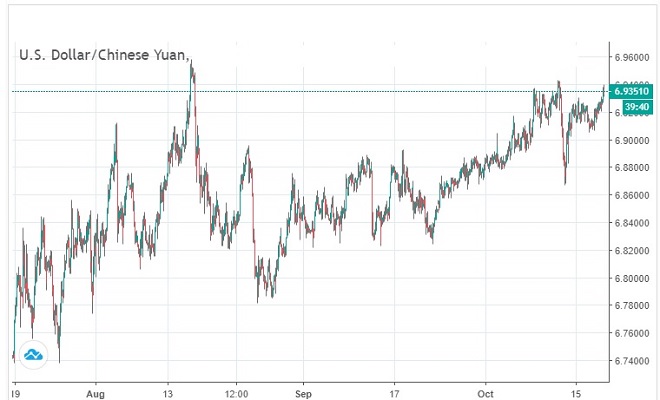
Following the Treasury Department’s report, the USDCNY increased 0.0052 or 0.08% to 6.9341 today from 6.9289 in the prior trading session. Historically, the Chinese Yuan recorded an all-time high of 8.73 in January 1994 and a record low of 1.53 in January 1981.
Disclaimer: Any financial trading analysis offered here is our opinion and is not intended as advice or direction for investors. We cannot guarantee the success of any trades made as a consequence of this article, and we encourage traders to incorporate a strong money management strategy to limit losses when they enter the markets. Please use this article as part of your own research before formulating strategies prior to trading.


