The euro remained range-bound against the greenback on Friday following the release of solid economic data from both the US and France. While French industrial production recorded robust growth in December, US nonfarm payroll employment data for January blew away estimates. Overall, the EUR/USD pair traded in a range of between 1.0780 and 1.0990.
According to the National Institute of Statistics and Economic Studies (INSEE), French industrial production grew by 1.10% m-o-m in December, following a 0.50% rise in the previous month and greater than forecasts of a 0.20% increase.
The manufacturing industry led the increase with a 1.20% m-o-m growth in December, following a 0.20% rise in the previous month. Also, the manufacturing of food products grew by 1.50% in December. Likewise, transport equipment recorded an increase of 1.60% m-o-m in December. Mining and quarrying, energy, and water supply inched up 0.20% in December. However, machinery and equipment goods manufacturing contracted by 2.40% in December. Coke and refined petroleum products fell by 1.70% in the same period.
The aggregate production during the final quarter of 2023 exhibited modest growth, surpassing the output recorded in the corresponding quarter of 2022 by 0.3% in the manufacturing sector. During this one-year period, mining and quarrying, energy, and water supply output grew by 5.90%. The manufacture of transport equipment rose by 6.60%. Also, machinery and equipment goods grew by 2.10%. Coke and refined petroleum products surged by 23.50%. However, the manufacture of food products and beverages output fell by 3.50%.
According to the US Bureau of Labor Statistics, the country’s nonfarm payroll employment increased by 353,000 in January, following an addition of 333,000 jobs in the previous month. This figure is nearly double the forecasted 187,000 jobs.
Professional and business services recorded an addition of 74,000 jobs in January. Likewise, healthcare added 70,000 jobs. While retail trade employment rose by 45,000 in January, social assistance recorded an addition of 30,000 jobs. Employment in the manufacturing sector inched up by 23,000 in January. Government employment increased by 36,000. Similarly, the information sector added 15,000 jobs. The mining, quarrying, and oil and gas sectors lost 5,000 jobs.
The statistical organization also stated that the US unemployment rate was 3.70% in January, unchanged from the previous month and a notch lower than forecasts of 3.80%. Notably, the unemployment rate remains unchanged for the third successive month. The number of jobless people stood unchanged at 6.10 million.
The number of long-term unemployed people was 1.30 million in January, unchanged from December. While the labor force participation rate was 62.50% in January, the employment-population ratio was 60.20%.
The solid economic data from both countries is expected to keep the EUR/USD pair range-bound in the short term.
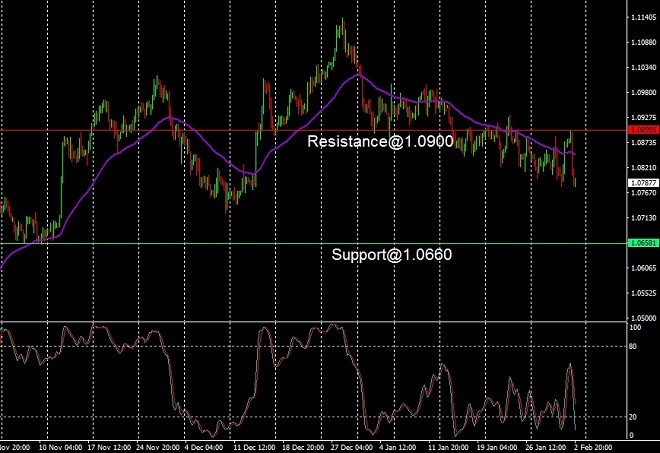
The historical price chart indicates that the EUR/USD pair is declining after failing to break the resistance at 1.0900. The next level of support is anticipated to be only near 1.0660. Additionally, the currency pair is trading below its 50-day moving average, while the stochastic indicator is in the bearish zone. Therefore, we anticipate the EUR/USD pair to remain in a downtrend in the near term.
Disclaimer: Any financial trading analysis offered here is our opinion and is not intended as advice or direction for investors. We cannot guarantee the success of any trades made as a consequence of this article, and we encourage traders to incorporate a strong money management strategy to limit losses when they enter the markets. Please use this article as part of your own research before formulating strategies prior to trading.