
The Aussie fell against the greenback yesterday despite the release of better-than-expected trade surplus data for May. The US ADP non-farm (private sector) job additions were overwhelmingly positive. This has once again increased bets on another Fed rate hike in the forthcoming policy meeting. Ultimately, this strengthened the US dollar against its rivals, including the Australian dollar. In the past 24 hours, the AUD/USD pair has declined from a high of 0.6686 to a low of 0.6625.
According to the data published by the Australian Bureau of Statistics, the country’s trade surplus rose to A$11.79 billion in May from A$10.45 billion in the previous month and was greater than forecasts of A$10.5 billion. The reported figure reflects the lowest surplus in eight months.
Goods and services exports grew 4.40% (or A$2.44 billion) to A$57.77 billion in May. Likewise, goods and services imports inched up 2.50% (or A$1.10 billion) to a four-month high of A$45.98 billion in the same period.
According to the data published by Automatic Data Processing, US non-farm employment grew by 497,000 in June, following an addition of 267,000 jobs in the previous month. Economists had anticipated only an addition of 228,000 jobs. The surge in job creation was led by the service sector, which added 373,000 jobs. Specifically, leisure and hospitality added 232,000 jobs.
Trade/transportation/utilities added 90,000 jobs. Likewise, the education/health sectors added 74,000 jobs. The information and financial sectors lost 30,000 and 16,000 jobs, respectively. Also, professionals/businesses lost 5,000 jobs.
The goods-producing sector added 124,000 jobs in June. In particular, the construction sector added 97,000 jobs. The mining sector added 69,000 jobs. However, the manufacturing sector lost 42,000 jobs.
Overall, small firms created 299,000 jobs. While medium-sized firms recorded an addition of 183,000 jobs, large firms posted a loss of 8,000 jobs.
According to the US Department of Labor, the country’s unemployment claims slightly increased to 248,000 in the week ended July 1 from 236,000 in the previous week and were higher than forecasts of 245,000. The four-week moving average declined to 253,250 from 256,750 in the earlier week.
The Job Openings and Labor Turnover Survey (JOLTS) data indicated a decline in the number of job openings to 9.80 million in May from 10.32 million in the previous month and missed forecasts of 9.93 million openings.
The healthcare and social assistance sectors recorded a decrease of 285,000 jobs. Likewise, the finance and insurance sectors posted a decrease of 139,000 jobs. On the contrary, educational services reported an increase of 45,000 jobs. Similarly, the domestic government education sector reported an increase of 37,000 openings. Additionally, federal government openings rose by 24,000.
The solid economic data from both countries and anticipation of another rate hike by the Federal Reserve are expected to keep the AUD/USD pair range-bound with a slight bearish bias in the near term.
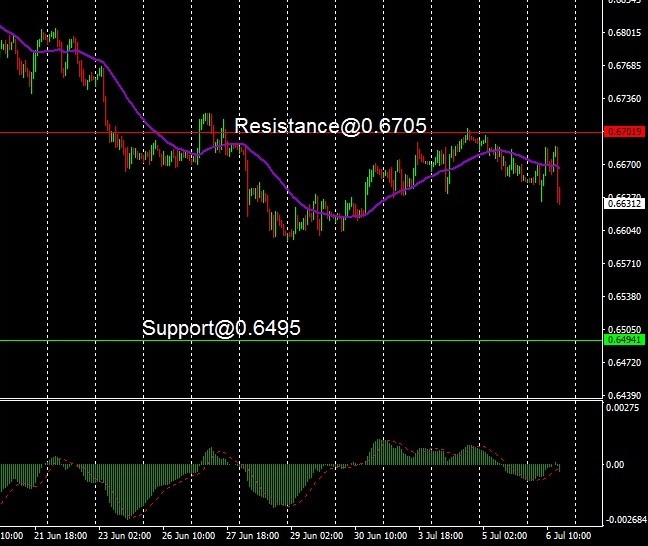
The historical price chart indicates that the AUD/USD pair is declining after facing resistance at 0.6705. The next support is anticipated to be near 0.6495. Additionally, the currency pair is trading below its 50-day moving average, while the MACD indicator is showing a negative reading. Therefore, we anticipate the AUD/USD pair to remain in a downtrend for the next few trading sessions.
Disclaimer: Any financial trading analysis offered here is our opinion and is not intended as advice or direction for investors. We cannot guarantee the success of any trades made as a consequence of this article, and we encourage traders to incorporate a strong money management strategy to limit losses when they enter the markets. Please use this article as part of your own research before formulating strategies prior to trading.