The euro rallied against the greenback yesterday despite the release of weak economic data from both Germany and the US. While the German trade surplus missed estimates, the US JOLTS job openings data did not meet expectations. However, anticipations of a further rate hike by the ECB kept the euro bullish against the greenback. Overall, the EUR/USD pair rallied from a low of 1.0880 to a high of 1.0965 in the past 24 hours.
According to German statistical organization Destatis, the country’s trade surplus was €16 billion in February, unchanged from the previous month but missing forecasts of €16.80 billion. The reported figure reflects the largest trade surplus since July 2021. Exports recorded the steepest growth in 10 months, reaching a historical high.
Specifically, exports grew by 4% m-o-m in February to €136.70 billion. On a y-o-y basis, exports surged by 7.60% in February 2023.
Imports grew by 4.60% m-o-m in February to €120.70 billion. On a y-o-y basis, imports increased by 3.80% in February 2023.
German exports to the EU grew by 2% m-o-m in February to €73.90 billion. Imports from the EU rose by 5.10% to €62.80 billion in the same period.
Likewise, German exports to countries outside the EU increased 6% m-o-m in February to €62.80 billion. Imports inched up 4% to €57.90 billion.
According to the Job Openings and Labor Turnover Survey data published by the US Bureau of Labor Statistics, the country’s job openings fell to 9.93 million in February from 10.56 million in the previous month and missed forecasts of 10.49 million.
Professional and business services recorded a decline of 278,000 job openings. Likewise, healthcare and social assistance posted a drop of 150,000 job openings. However, construction and arts, entertainment, and recreation recorded increases of 129,000 and 38,000 job openings, respectively.
According to the US Census Bureau, the country’s factory orders declined 0.70% m-o-m in February, following a 2.10% drop in the previous month and worse than forecasts of a 0.40% contraction.
Fresh orders for manufactured goods fell by 0.70% (or $3.90 billion) in February to $536.40 billion.
Shipments declined by 0.50% (or $2.80 billion) in February to $542.80 billion. Unfilled orders dropped by 0.10% (or $1.10 billion) to $1.156 trillion. While the unfilled orders-to-shipments ratio was 6.10 in February, up from 6.09 in January, Also, the inventories-to-shipments ratio inched up to 1.49 in February from 1.48 in January.
Fresh orders for manufactured durable goods fell by 1% (or $2.70 billion) to $268.40 billion. Likewise, new orders for manufactured nondurable goods decreased by 0.40% (or $1.20 billion) to $268.10 billion.
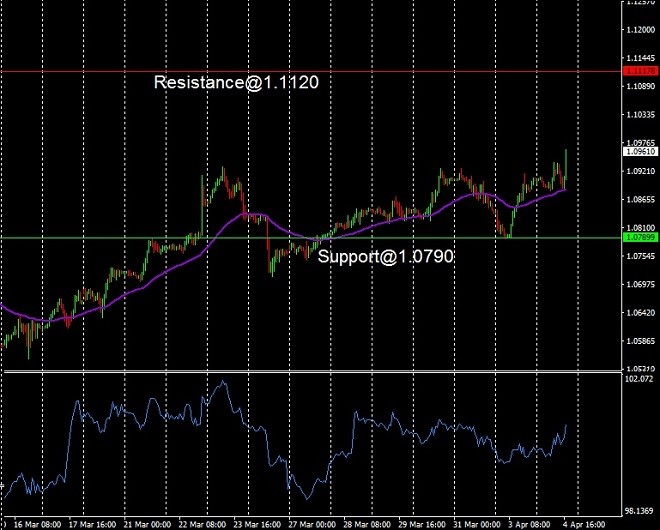
The weak economic data from both the Eurozone and the US and expectations of further rate hikes by the European Central Bank are expected to keep the EUR/USD pair range-bound with a slight bullish bias in the short term.
The historical price chart indicates that the EUR/USD pair is ascending after bouncing off the support at 1.0790. The next resistance is anticipated only near 1.1120. Additionally, the currency pair is trading above its 50-day moving average while the momentum indicator is rising. Therefore, we anticipate the EUR/USD pair to remain in an uptrend in the short term.
Disclaimer: Any financial trading analysis offered here is our opinion and is not intended as advice or direction for investors. We cannot guarantee the success of any trades made as a consequence of this article, and we encourage traders to incorporate a strong money management strategy to limit losses when they enter the markets. Please use this article as part of your own research before formulating strategies prior to trading.