The Aussie declined against the greenback yesterday following the announcement of a 25bps rate hike by the US Federal Reserve. The Australian consumer price index data for the June quarter also missed estimates. Both factors enabled the greenback to gain ground against the Aussie. Overall, the AUD/USD pair declined from a high of 0.6793 to a low of 0.6730 in the past 24 hours.
According to the Australian Bureau of Statistics, the country’s consumer price index (CPI) inched up 0.80% q-o-q in the June 2023 quarter following a 1.40% rise in the March 2023 quarter but missed forecasts of 1% growth.
Additionally, the CPI rose by 5.40% in the year ended June, slightly lower than the 5.50% increase recorded in the year ended May. The reading encompasses volatile goods. Travel surged 6.10% in June, a decrease from 6.40% growth in May.
Furthermore, annual trimmed mean inflation stood at 6% in June, slightly lower than the increase of 6.10% in May.
Housing prices surged 7.40% in the year ended June. Specifically, new dwelling prices grew by 6.60% in June. Also, electricity prices rose by 10.20%. While food and non-alcoholic beverages increased by 7% in June, recreation and culture rose by 6.80% in the same period.
Food products posted an increase of 10.50% in June. In particular, bread and cereal products grew by 10.90%, while dairy and related items increased by 15%. This was offset by a 10.60% decline in automotive fuel in June. Notably, holiday travel and accommodation surged 12.90% in the year ended June 2023.
According to the US Census Bureau, the country’s new single-family house sales were 697,000 units in June, down from 715,000 units (downwardly revised from 763,000 units) in the previous month and missing forecasts of 726,000 units. The reported figure is 23.80% higher than the June 2022 estimate of 563,000 units.
At the end of June, the number of new houses for sale was 432,000, representing a supply of 7.40 months at the prevailing sales rate.
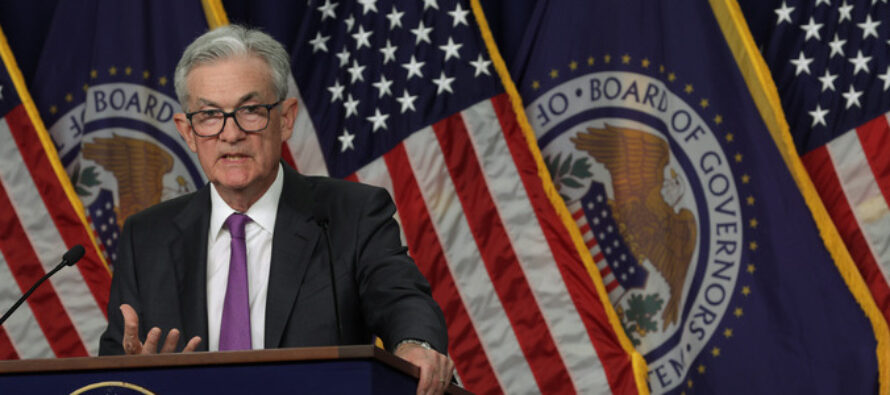
In the US session, in spite of a recent decline in inflationary pressure, the US Fed lifted its benchmark interest rate by 25bps to 5.50%, reflecting the highest level in 22 years. Furthermore, the Fed signaled the likelihood of another rate hike in the months ahead against the backdrop of robust economic activity.
Following a two-day monetary policy meeting, the Fed once again stated that there is a need to raise rates in order to bring inflation to the Fed’s targeted level of 2%. While the Fed’s Chair, Jerome Powell, acknowledged the inflationary slowdown in June, he pointed out that conclusions cannot be drawn based on just one month of data.
Powell further elaborated that the Federal Reserve will have the opportunity to review two additional inflation statistics and two jobs data sets prior to its upcoming policy meeting in September. He expressed that there is a potential for a benchmark interest rate increase during the September meeting, but it is also plausible that the rates may remain unchanged.
The rate hike and slightly hawkish statement by the Fed are expected to keep the AUD/USD pair range-bound with a slight bearish bias in the short term.
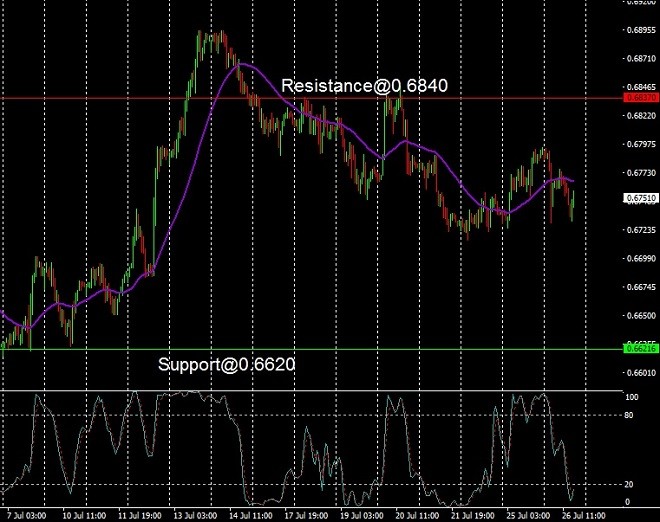
The historical price chart indicates that the AUD/USD pair is descending after facing resistance at 0.6840. The next major support is anticipated to be near 0.6620. Additionally, the currency pair is trading below its 50-day moving average, while the stochastic indicator is in the bearish zone. Therefore, we anticipate the AUD/USD pair to remain in a downtrend in the days ahead.
Disclaimer: Any financial trading analysis offered here is our opinion and is not intended as advice or direction for investors. We cannot guarantee the success of any trades made as a consequence of this article, and we encourage traders to incorporate a strong money management strategy to limit losses when they enter the markets. Please use this article as part of your own research before formulating strategies prior to trading.