
The yen remained range-bound against the US dollar yesterday despite the release of better-than-anticipated industrial production and tertiary industry activity data for August. The US Empire State manufacturing index data also worsened in October. However, the Fed’s hawkish stance, geopolitical issues (Russia-Ukraine war), the UK’s political uncertainty, and a gloomy economic scenario continue to bolster the US dollar against its rivals, including the yen. Overall, the USD/JPY pair traded in a narrow range of 148.40 and 148.70 in the past 24 hours.
According to Japan’s Ministry of Economy, Trade, and Industry (METI), the country, industrial production grew by 3.40% m-o-m in August, following an expansion of 0.80% in the prior month, and greater than the preliminary estimate of a 2.70% increase. Economists did not anticipate any change in the initial estimate. Correspondingly, the production index was 100.20 at the end of August.
The reported numbers reflect the third successive month of an increase in industrial output, primarily led by a 6.20% rise in production machinery. Iron, steel, and non-ferrous metals posted a 3.60% increase. Chemicals recorded a 4.40% growth.
Shipments grew by 2.80% while inventories rose by 0.70%. Subsequently, the inventory ratio fell by 3% in August.
On a y-o-y basis, Japan’s industrial output grew by 5.80% in August 2022, rebounding from a 2% decline in July and rising for the first time in six months.
A separate news release published by the METI indicates that Japan’s tertiary industry activity grew by 0.70% m-o-m in August, following a decline of 0.50% in the prior month, and more than double the 0.30% rise anticipated by economists.
Correspondingly, the tertiary industry activity index was 100 in August. On a y-o-y basis, the tertiary industry’s activity grew by 4.2% in August 2022.
As per the data published by the Federal Reserve Bank of New York, the Empire State Manufacturing index worsened to -9.10 in October, from -1.50 in September. Economists had forecast a decline to -4.30.
The new orders index remained unaltered at 3.70 in October, reflecting a slight rise in orders. Also, the shipment index plummeted 20 points to -0.30. The unfilled orders index was -3.70 in October. Eventually, the future business conditions index dropped 10 points to -1.80 in October, indicating that companies do not forecast an improvement in conditions in the forthcoming six months.
The robust Japanese economic data and hawkish Fed stance are expected to keep the USD/JPY pair range-bound in the days ahead.
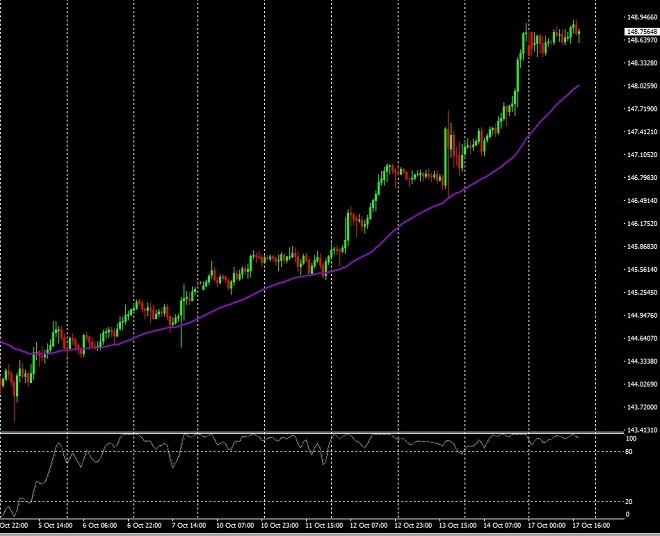
The historical price chart clearly shows that the USD/JPY pair is in a long-term uptrend. The currency pair is trading above its 50-day moving average while the stochastic indicator is in the bullish zone. Therefore, we anticipate the currency pair to continue in an uptrend in the short term.
Disclaimer: Any financial trading analysis offered here is our opinion and is not intended as advice or direction for investors. We cannot guarantee the success of any trades made as a consequence of this article, and we encourage traders to incorporate a strong money management strategy to limit losses when they enter the markets. Please use this article as part of your own research before formulating strategies prior to trading.