

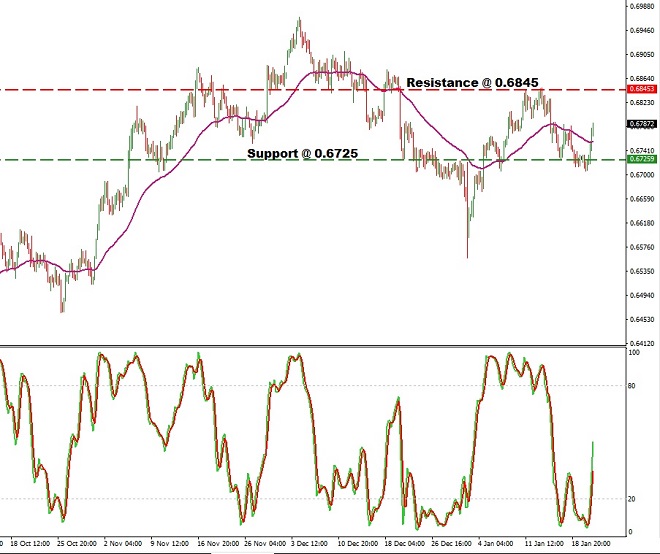
The New Zealand dollar started climbing yesterday after Statistics New Zealand reported better-than-expected inflation data. Before the inflation data was published, the antipodean currency was moving either down or sideways against its major peers. The increase in dairy product prices for the fourth consecutive session and diminishing prospects of a rate cut also fueled the Kiwi dollar’s rally. From a low of about 0.6720, the NZD/USD currency pair has rallied to a high of 0.6780 in the past 24 hours.
Higher dairy product prices, rising inflation propels the Kiwi dollar
International dairy product prices rose 4.2% at the Global Dairy Trade auction conducted on January 15, after declining in the majority of auctions last year. After four successive auctions of price rises, the average price of dairy products stood at $3,057 a ton, compared with $2,986 in the first week of January. Nearly 27,909 tons of dairy products were sold, a marginal decrease from 28,651 tons auctioned two weeks ago. Notably, the price of dairy products increased by 2.8% in the previous auction conducted on January 2nd. New Zealand is the world’s biggest dairy exporter.
The price of skim milk powder soared 10.3% to S$2,405 per ton in the recent auction. Likewise, the cost of lactose jumped 7.9% to $1,032 per ton. The amount of Whole milk powder grew 3% to $2,777 a ton.
Commenting on the rise in dairy product prices, NZX dairy analyst, Robert Gibson, said “Overall, the results were in line with the NZX Dairy Derivatives market expectations leading into the event. Offer volumes for whole milk powder were unchanged on the previous event at 17,350 tonnes, but up 39 percent on the previous year, indicating stronger demand for available volumes.”
Yesterday, Statistics New Zealand revealed that consumer prices increased by 0.1% q-o-q in the December quarter. The reported figures surpassed anticipations of a flat reading after the 0.9% rise in the previous quarter.
On the inflation data, Kiwibank chief economist Jarrod Kerr said: “We’re taking this as actually a positive number, and we have an economy that’s grown at a decent clip, starting to produce a bit of inflation, and we’re looking good into 2019.”
Similarly, ASB economist Kim Munday said “Inflation pressure is building underneath the surface, and we haven’t had meaningful inflation in New Zealand for ten years. So this is a good sign. For the Reserve Bank, it’s a good thing because it means that we’re one step closer to core inflation getting back in line with the mid-point of their target band.”
The rise in inflation has also made analysts revisit their rate cut forecasts. Many economists believe that the Reserve Bank of New Zealand would refrain from announcing additional rate cuts due to an improvement in the inflationary pressure.
Ben Udy, a Singapore-based economist for Capital Economics, said: “All told, the improvement in underlying inflation means the RBNZ won’t be cutting interest rates anytime soon. But with headline inflation set to fall further below target, combined with a slowing in GDP growth, we think that rate hikes remain a distant prospect.”
Notably, the market was giving a 50% for a rate cut before the inflation data came in. In November RBNZ issued a neutral-sounding statement saying the next move is dependent on the performance of the economy. With the rise in inflationary pressure, the RBNZ would prefer to delay any rate cut plans it may have.
The rise in dairy product prices, an increase in inflationary pressure, and diminishing prospects of a rate cut are expected to keep the New Zealand dollar bullish in the short-term.
Technically, the Kiwi dollar has received support at 0.6725. Furthermore, the stochastic indicator is rising towards the bullish zone. The next resistance is expected only near 0.6850. As a result, we can expect the NZD/USD pair to move up in the short-term.
Disclaimer: Any financial trading analysis offered here is our opinion and is not intended as advice or direction for investors. We cannot guarantee the success of any trades made as a consequence of this article, and we encourage traders to incorporate a strong money management strategy to limit losses when they enter the markets. Please use this article as part of your own research before formulating strategies prior to trading.


