
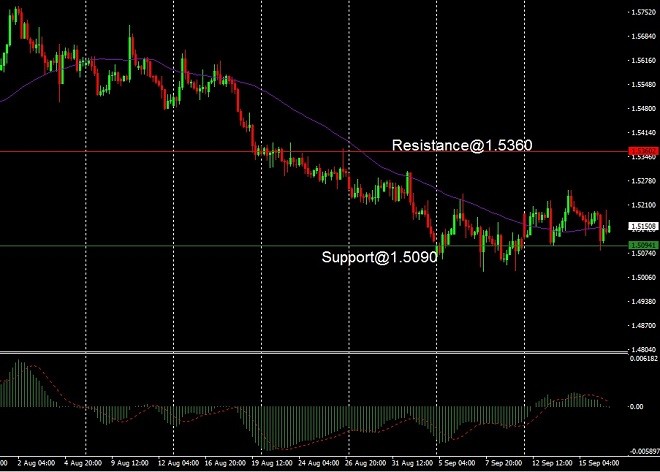
The pound remained range bound against the loonie on weak economic data from both the UK and Canada. While the UK’s retail sales volumes were worse than anticipated in August, Canada’s wholesale sales fell more than anticipated in July. Overall, the GBP/CAD pair remained range bound between 1.5090 and 1.5291 on Friday last week.
According to the ONS, the UK’s retail sales volumes fell by 1.60% m-o-m in August, following a 0.40% rise in the prior month, and worse than forecasts of 0.50% decline.
The decline was led by non-food stores, which posted a 1.90% m-o-m drop in volumes. All sub-sectors in the non-food store’s category posted a decrease. Specifically, department stores recorded a drop of 2.70%, and household goods stores posted a decrease of 1.10%.
Non-store retailing sales volumes decreased 2.60% in August. In spite of the decline, sales volumes stood 24.40% above pre-pandemic February 2020 levels.
Food store sales volume inched down 0.80%, taking it 1.40% below pre-pandemic February 2020 levels.
Automotive fuel sales volumes declined by 1.70% in August, taking it 9% lower than February 2020 levels.
The percentage of online retail sales declined to 25.70% in August, from 26.30% in July, but still remains considerably higher than the February 2020 level of 19.80%.
According to Canada Mortgage and Housing Corporation (CMHC), the country’s housing starts fell to 267,443 units in August, from 275,000 units in the prior month, but surpassed forecasts of 264,000 units.
Urban starts declined 3% to 246,771 units as multi-unit urban starts fell by 4% to 187,602 units. Also, single-detached urban starts inched up 1% to 59,169 units. Rural starts stood at 20,672 units.
According to Statistics Canada, the country’s wholesale sales declined 0.60% m-o-m in July to C$80.20 billion, following a rise of 0.10% in the prior month, and worse than the decrease of 0.40% anticipated by economists.
Sales dropped in five out of seven subsectors, which accounted for 63% of wholesale sales. Personal and household goods sales declined 2.60% to C$10.80 billion in July. The figure reflects the second successive month of decrease in sales.
The textile, clothing, and footwear sector paved the way for losses as it decreased 13.20% to C$1.30 billion in July. This is the second successive double-digit percentage decline for the industry.
Sales of building materials and supplies recorded a decrease of 1.70% in July to C$12.80 billion. On the contrary, sales of machinery, equipment, and supplies recorded a 1.60% rise to C$17 billion.
Wholesale inventories grew by 1.20% to C$121.50 billion in July, reflecting the sixth successive monthly rise. Six of the seven subsectors posted an increase in inventories.
Inventories in the machinery, equipment, and supplies subsector grew by 1.50% to C$33 billion. Likewise, inventories in the motor vehicle and motor vehicle parts and accessories subsector surged 3.4% in July to C$13 billion.
The food, beverage, and tobacco subsector also posted a 2.10% rise in inventories to C$13.30 billion. The increase was primarily due to a 1.60% growth in the food sector. Overall, the inventory-to-sales ratio inched up to 1.51 in July, from 1.49 in June.
The mixed economic data from both countries are expected to keep the GBP/CAD pair range bound in the short term.
The historical price chart indicates that the GBP/CAD pair has solid support at 1.5090. The next resistance is anticipated only near 1.5360. Additionally, the currency pair is trading above its 50-day moving average while the MACD indicator is showing a positive reading. Therefore, we anticipate the currency pair to remain in an uptrend in the days ahead.
Disclaimer: Any financial trading analysis offered here is our opinion and is not intended as advice or direction for investors. We cannot guarantee the success of any trades made as a consequence of this article, and we encourage traders to incorporate a strong money management strategy to limit losses when they enter the markets. Please use this article as part of your own research before formulating strategies prior to trading.