
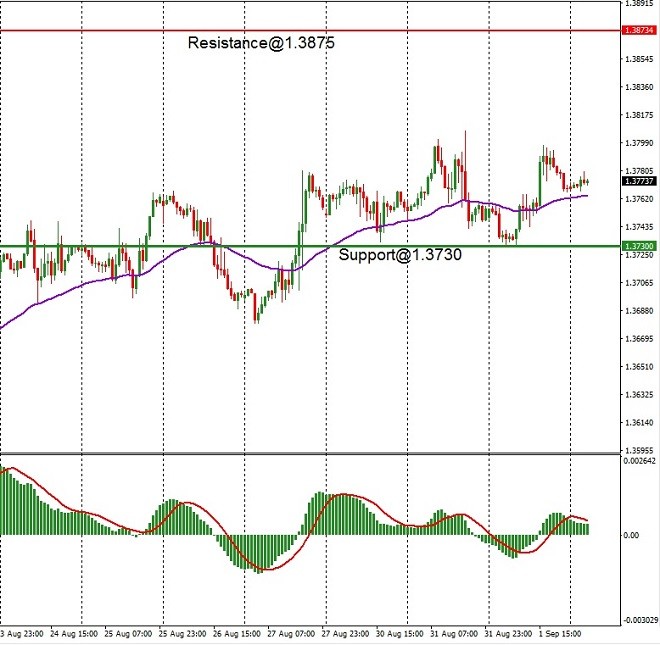
The pound gained ground against the greenback following the report of slightly better than anticipated UK manufacturing PMI data by the IHS Markit. The economic data from the US was mixed. Furthermore, the recent dovish statement made the US Fed Chair Jerome Powell continues to keep the greenback weak against its major rivals. Overall, the GBP/USD pair rallied from a low of 1.3730 to a high of 1.3795.
According to IHS Markit, the UK’s final manufacturing PMI (purchasing managers’ index) dropped to a five-month low of 60.30 in August, from 60.40 in July and a few notches higher than the preliminary reading of 60.10. Economists had anticipated no change in the preliminary reading. Despite the decline, the reported reading is still higher than the long-term average of 51.90. Notably, the PMI reading has reflected an improving operating performance for the last 15 months in a row.
Once again, in August, manufacturing output increased, although at the weakest level since February. Intermediate goods producers posted the weakest growth.
Incoming fresh business increased in August, mirroring a rise in inflows from both local and foreign markets. Specifically, manufacturers recorded a rise in orders from customers in China, the US, Europe, South America, and Asia.
The UK manufacturing sector’s confidence increased to a three-month high, mirroring anticipations of a sustained economic rebound, robust worldwide demand, and investment plans, in addition to a strong belief in the lessening or even total clearance of supply chain problems.
For the eighth successive month, employment rose to reach a new high. Also, average supplier lead times increased to the second-longest level. Even average selling prices increased at the quickest pace on record.
According to the data published by Automatic Data Processing, Inc., non-farm (private sector) payrolls increased by 374,000 in August, following an increase of 326,000 additions in the prior month, but missed the 640,000 non-farm payroll increase anticipated by economists.
While medium businesses added 149,000 jobs, large businesses increased employment by 138,000.
Goods-producing industries recorded an addition of 45,000 jobs, out of which the construction sector contributed 30,000 jobs.
Service-providing industries added 329,000 jobs. Specifically, leisure/hospitality reported 201,000 jobs. Also, education/health services recorded 59,000 jobs.
According to the Institute for Supply Management, the US manufacturing PMI (purchasing managers’ index) inched higher to 59.90 in August, from 59.50 in July, and surprised analysts who anticipated a decrease in the reading to 58.50.
The reported figure reflects the overall economic expansion for the 15th consecutive month, following a contraction in April 2020. The new orders index rose by 1.80% m-o-m to 66.70% in August. Likewise, the production index grew 1.6% to 60%. Also, the backlog of orders index gained 3.2% to 68.20% in August. While the inventories index increased 5.30% to 54.20%, the new export orders index rose by 0.90% to 56.60%.
On the contrary, the prices index fell by 6.30% to 79.40%, reflecting the first decline below 80% since December last year (77.60%). Similarly, the employment index shrank 3.90% to 49%.
According to the final estimate published by IHS Markit, the US manufacturing PMI (purchasing managers’ index) declined to 61.10 in August, from 63.40 in July. The flash estimate had pegged the manufacturing PMI at 61.20. Economists did not anticipate any change in the flash estimate. The reading, reflecting an expansion, was the softest in four months. However, it still remains one of the best readings since the organization started publishing the data 14-years back.
The decline in the pace of output growth was mainly due to capacity issues and material scarcity. Raw material supply times increased further, while input prices rose sharply. Additionally, the inflationary pressure hit a new series high.
The Fed’s dovish stance is expected to keep the US dollar weakened against other major currencies in the short term.
The historical price chart reveals that the GBP/USD money pair has bounced off the support at 1.3730. The next resistance is expected near 1.3875. Additionally, the currency pair is trading above its 50-day moving average, while the MACD indicator has a positive reading. We are therefore expecting the GBP/USD pair to stay in an uptrend in the coming day.
Disclaimer: Any financial trading analysis offered here is our opinion and is not intended as advice or direction for investors. We cannot guarantee the success of any trades made as a consequence of this article, and we encourage traders to incorporate a strong money management strategy to limit losses when they enter the markets. Please use this article as part of your own research before formulating strategies prior to trading.