Following the imposed sanctions by the US, bank deposits in the Turkish lira declined by the end of August. As the lira started weakening against the greenback, the value of foreign currency loans surged. In an effort to prevent economic collapse, the government has ordered exporters to convert a major portion of the export revenue into lira – a move that surprised economists as it could put the manufacturers in trouble.
Turkish exporters become the scapegoat
During the course of the current year, the lira has fallen by more than 40%, resulting in a steep rise in the cost of fuel and food. The inflation rate is currently at 18%, the highest level in the past fifteen years, but this is not the first time Turkish currency suffered a disastrous devaluation.
In 2001, following an order to investigate corruption, the then president threw a copy of the constitution at the prime minister, and the currency plunged due to this incident. This time around it occurred due to the 25% and 50% hike in aluminum and steel tariffs announced by US President Trump that triggered the devaluation of the currency.
On August the 31st, lira deposits at banks in Turkey were 1.005 trillion liras (~$153 billion), down 2.4% from August the 20th. Likewise, total foreign currency deposits held by Turks in the country and abroad also declined 1% to $183.70 billion as Turks resorted to diluting a portion of their Forex holdings.
Commenting on the decline, Ajay Chhibber, who reigned as the World Bank’s chief in Turkey from 1997 to 2003, said: “Today Turkey faces a currency crisis, but if the lira remains weak, this could turn into a banking crisis.” Chhibber further stated that such a scenario would cause a deep recession and a ripple effect on western banks.
Economists have stated that such measures cannot resolve the issue permanently. The country, according to economists, needs big rate hikes to avoid further depreciation of the lira and keep inflation under control. The central bank, however, is toeing the line of President Tayyip Erdogan, a self-proclaimed enemy of interest rates.
As per the order announced last week, Turkish exporters must convert a minimum of 80% of their foreign exchange revenue into domestic currency within one hundred and eighty days of receiving payment. The order became effective last Tuesday and will remain in effect for the next six months. Notably, Turkey exported $157 billion worth of goods last year.
Commenting on the government’s decision to restrict exporters from holding foreign exchange, Seref Fayat, head of the clothing committee at Turkey’s well-known industry group TOBB, said the criteria could result in losses for exporters who purchase raw materials abroad or have cross-border loans.
Expressing his disappointment, Fayat said: “There will be a problem when your due date comes for a loan, or you would need to buy raw material with foreign currencies. This decision needs to be amended.”
Fayat wants foreign exchange liabilities to be taken into account while calculating the amount to be converted into the lira.
To calm the nerves of the exporters, Finance Minister Berat Albayrak, met with Turkish exporters to discuss the new mandate. Albayrak promised to amend the agreement in favor of exporters. Rough estimates indicate that the regulation could cost exporters $3 to $4 billion, which includes currency conversion costs.
Exporters were disappointed as the government announced the decision unilaterally without asking for the opinion of exporters. Turkey, which shares a customs union with the EU, exported $15 billion worth of goods to Germany last year with Germany is the largest importer of Turkish goods. Britain, the UAE, the US, and Iraq are other major markets for Turkish products.
Turkey is a big exporter of clothing, textiles, steel, and cars. Still, it is dependent on overseas raw materials for manufacturing. Anywhere between 65% and 90% of the revenue generated from the iron and steel sector is spent on raw material imports, explained Namik Ekinci, Head of the steel federation, an industry group. Ekinci also criticized the rule as “illogical.”
By refusing to accept the US terms, Turkey is fast turning into an unstable economy. Following the previous currency issue in 2001, it took several years for the country to return to single-digit inflation, an effective banking system, an easy mortgage facility, and an independent central bank without any government interference.
As of now, however, it seems Turkey has fallen back into the vicious cycle of low growth and high inflation. The economy of the US, which imposed a sanction, continues to perform exceedingly well. So, fundamentally, the greenback continues to gain ground against the lira.
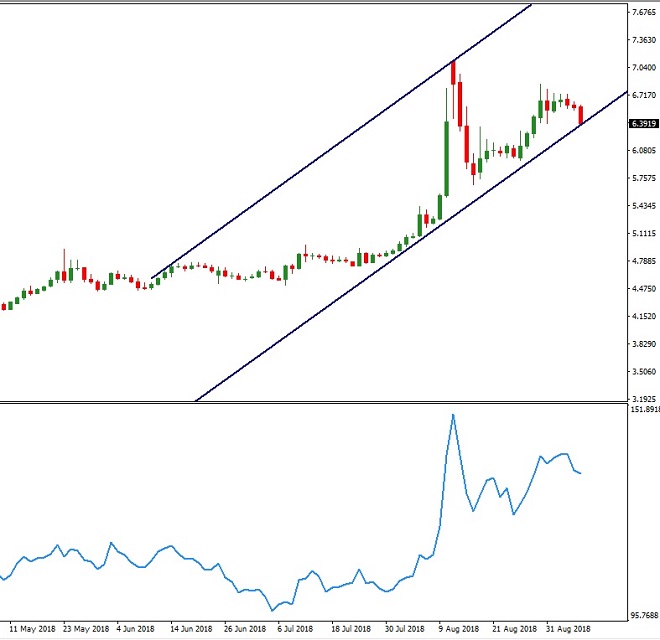
Technically, the USDTRY pair is still moving along an ascending channel. The momentum indicator is also rising. Therefore, we can expect the USDTRY to remain in an uptrend.
Disclaimer: Any financial trading analysis offered here is our opinion and is not intended as advice or direction for investors. We cannot guarantee the success of any trades made as a consequence of this article, and we encourage traders to incorporate a strong money management strategy to limit losses when they enter the markets. Please use this article as part of your own research before formulating strategies prior to trading.