Yesterday, the South African rand’s four-day rally against the US dollar was abruptly halted after U.S. President, Donald Trump, announced he has asked the Secretary of State to study South Africa’s land politics, triggering concerns that it may be next in line to face US sanctions. The rand, which is well-known for its wild swings based on global market sentiment, is also one of the most actively traded emerging market currencies. Trump’s unforeseen interest in South Africa’s land acquisition controversy, comes at a time when President Cyril Ramaphosa’s government (due to face elections next year) faces a decline in demand for emerging-market assets, amidst worries over a potential US-China trade war and a lack of stimulus within developed economies.
The Expropriation Act
In February this year, the ruling African National Congress passed a resolution that gave free rein to confiscate land without any kind of compensation. The resolution, in part, reads as follows: “With the concurrence of the National Council of Provinces (NCOP) instruct the Constitutional Review Committee to review section 25 of the Constitution and other clauses where necessary to make it possible for the state to expropriate land in the public interest without compensation.”
The Expropriation Act clearly poses a question mark over the South African government’s commitment to private property rights. Despite concerns, President Ramaphosa confirmed earlier this month that the government will go ahead with land confiscation under the reformed Act.
The issue has caused an uproar among investors outside South Africa, but the US appeared to hardly take notice of the issue. However, the matter took a twist when a Cato Institute’s blog post called for US intervention in the issue. Cato, a Washington-based Libertarian ‘think-tank’, was founded by Charles Koch, CEO of Koch Industries (the second-largest privately owned company in the US).
Replying to Cato’s post, Trump tweeted: “I have asked Secretary of State @SecPompeo to closely study the South Africa land and farm seizures and expropriations and the large scale killing of farmers. “South African Government is now seizing land from white farmers.” @TuckerCarlson”
Supporters of the land expropriation argue that only such a bold move could enable a fair opportunity to black South Africans; indicating the continued existence of extreme racial disparity in farmland ownership.
However, enactment of this new legislation is expected to keep investors away from commitments within the ailing economy. Critics also point to the current state of Zimbabwe as a warning to South Africa not to tread the same path.
The USDZAR relationship
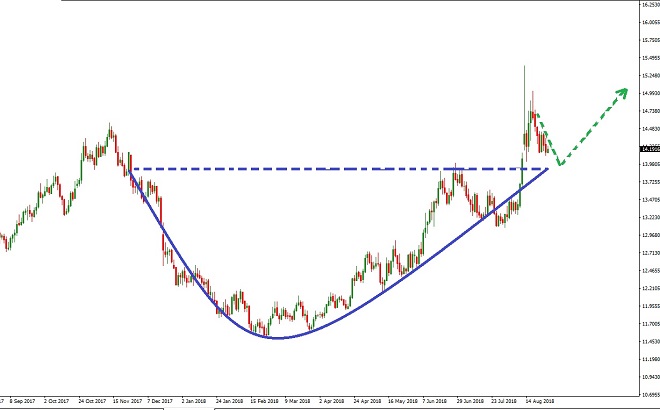
Technically speaking, at present, the USDZAR has recently formed a cup and handle pattern (as shown in the image below). As the neckline of the cup has been broken, analysts expect a large rally to occur in the USDZAR pair, sometime in the week ahead.
However, in the past three months, the rand lost 1.9% against the US dollar – the largest fall among its peers.
South Africa’s Department of International Relations and Cooperation has responded to Trump’s tweet saying that it will meet officials at the US embassy “to seek clarification on the matter.” The Department described Trump’s tweet as “unfortunate” and based on erroneous data. The South African government stated that it rejects this “narrow perception, which only seeks to divide our nation.”
Fed Chair, Jerome Powell’s latest statement provides further reason for the rand to soften against the greenback. While speaking at the Annual Symposium of Central Bankers at Jackson Hole, Powell stated that the Fed would gradually hike rates. Trump wants Powell to adopt a loose fiscal policy, however, Powell’s statement asserted that the Fed will not fall in line with political expectations, and would continue to do what is best for the US and global economy as a whole.
Disclaimer: Any financial trading analysis offered here is our opinion and is not intended as advice or direction for investors. We cannot guarantee the success of any trades made as a consequence of this article, and we encourage traders to incorporate a strong money management strategy to limit losses when they enter the markets. Please use this article as part of your own research before formulating strategies prior to trading.