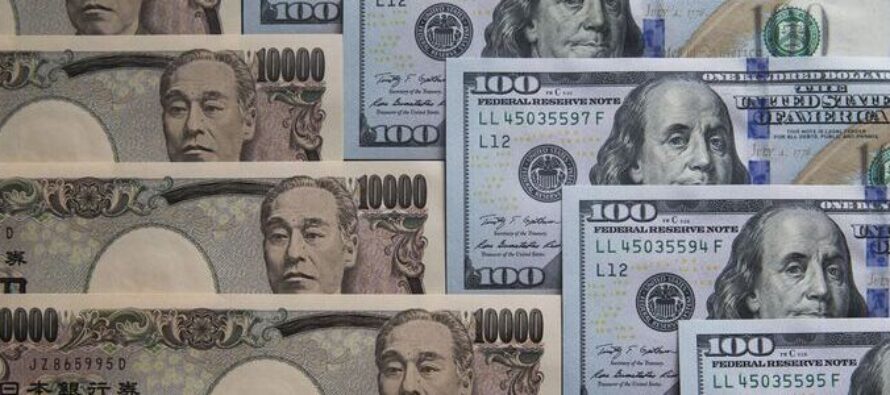
The greenback declined against the yen following the report of slightly lower than anticipated fourth-quarter US GDP growth. Notably, earlier in the Asian session, the Japanese Ministry of Economy, Trade and Industry reported worse than anticipated retail sales data for February. However, the market was focused on the US GDP data. The USD/JPY pair fell from a high of 123.20 to a low of 121.30 in the past 24 hours.
The Ministry of Economy, Trade and Industry (METI) stated that Japan’s retail sales contracted 0.80% y-o-y in February, following an increase of 1.10% in the prior month and worse than the 0.30% decline anticipated by economists. The stated figure was the first decline in retail trade since September 2021 as sales dropped for several commodities, including a 1.60% decrease in general merchandise, 2.70% drop in fabric apparel & accessories, 0.60% decline in food & beverages, 14.80% fall in motor vehicles and 8.30% decrease in machinery & equipment.
During the same period, sales rose by 21.60% in fuel. On a m-o-m basis, retail sales fell by 0.80% in February, the third consecutive monthly decline, following a downwardly amended 0.90% decrease in January.
The ADP employment report showed the US private sector payrolls increased by 455K jobs in March, following an addition of 486,000 jobs in the prior month and slightly greater than the 450,000 job additions expected by economists.
Small businesses added 90,000 jobs, while medium businesses had job additions of 188,000. Large businesses posted job additions of 177,000.
Sector-wise, goods-producing industries added 79,000 jobs. Under the goods-producing sector, the construction and manufacturing sectors added 15,000 and 54,000 employment opportunities, respectively.
Service providing sector added 377,000 jobs. In particular, leisure/hospitality sector added 161,000 jobs, while education/health services added 72,000 jobs. Professional/business services added 61,000 jobs. Also, trade/transportation/utilities sector added 49,000 jobs.
The final estimate provided by the US Bureau of Economic Analysis revealed that the country’s economy expanded at an annual rate of 6.90% q-o-q in the December 2021 quarter, compared with a GDP growth of 2.30% in the September 2021 quarter, but a notch lower than the second estimate of 7%. Analysts did not expect any variation in the second estimate.
The increase in GDP was led by a growth in private inventory investment, a rise in exports and residential fixed investment, and an increase in consumer spending. This was negated by a drop in local government spending. Imports also increased considerably.
On an annual basis, GDP surged by 14.50% (or $800.50 billion) to $24 trillion in 4Q 2021. In the prior quarter, GDP rose by 8.40% (or $461.30 billion).
The price index for gross domestic purchases rose by 7% q-o-q in the fourth quarter, compared with a rise of 5.60% in the third quarter. The stated figure was in line with economists’ estimates.
The PCE price index grew by 6.40% in Q4 2021, compared with a rise of 5.30% in Q3 2021. Excluding food and energy prices, the PCE price index grew by 5%, compared with a rise of 4.60%.
The weak economic data from Japan and the US is predicted to keep the USD/JPY pair range-bound in the short term.
The historical price chart shows the USD/JPY pair is declining after facing resistance at 123.85. The next major support is expected only near 120.55. Also, the currency pair is trading below its 50-day moving average, while the MACD indicator has a negative reading. We are anticipating the currency pair to stay in a downtrend in the short term.

Disclaimer: Any financial trading analysis offered here is our opinion and is not intended as advice or direction for investors. We cannot guarantee the success of any trades made as a consequence of this article, and we encourage traders to incorporate a strong money management strategy to limit losses when they enter the markets. Please use this article as part of your own research before formulating strategies prior to trading.