
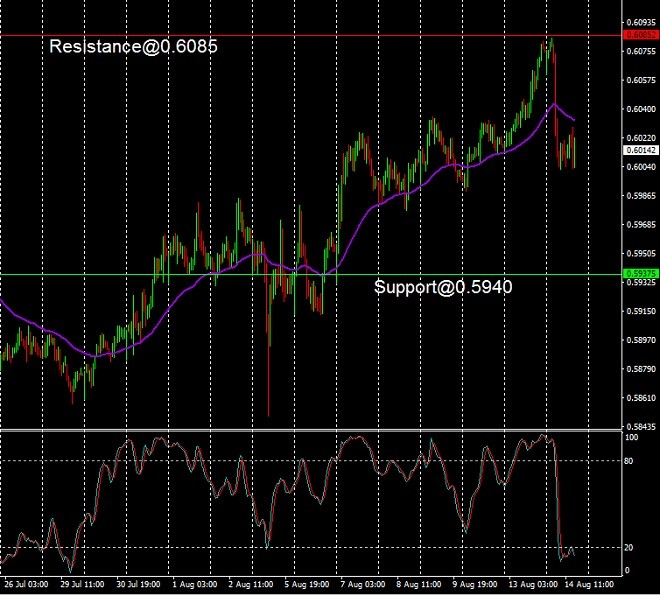
The Kiwi dollar lost ground against the greenback yesterday following the announcement of a rate cut by the Reserve Bank of New Zealand and the accompanying dovish policy statement. The US inflation data was in line with economists’ expectations. This fueled the New Zealand dollar’s decline against the greenback. Overall, the NZD/USD pair fell from a high of 0.6085 to a low of 0.6002 in the past 24 hours.
New Zealand’s central bank (RBNZ) has slashed its benchmark interest rate by 25 basis points to 5.25%, broadly in line with economists’ expectations. This represents the first cash rate cut since March 2020. The RBNZ has held the interest rate unchanged since May 2023.
This decision, which came roughly a year before the Reserve Bank of New Zealand’s (RBNZ) projections, marked a dovish shift that triggered a sell-off in the Kiwi dollar. The RBNZ indicated that more cuts are expected in the coming months as inflation approaches its target range of 1% to 3%.
The central bank’s statement emphasized the necessity of easing monetary policy limitations, hinting at further reductions based on inflation trends.
Swaps markets have adjusted to reflect an additional 32 bps of rate cuts by October and 71 basis points by the end of 2024. Projections now suggest rates could fall to approximately 3.0% by the end of the next calendar year, significantly lower than the RBNZ’s forecast of 3.85%. Despite the dovish stance, the RBNZ maintained a cautious outlook, indicating that monetary policy would need to stay limited for a period to manage inflation effectively.
Following the interest rate cut announcement, RBNZ Governor Adrian Orr stated that economic growth has been declining since May, with reduced worries about pricing expectations. The central bank anticipates New Zealand will experience a technical recession in the months ahead, following successive economic contractions last year and the previous year.
The RBNZ’s outlook signals a minimum of three more rate cuts by mid-2024, forecasting a cash rate of 4.9% in 4Q 2024 and 4.4% by 2Q 2025. This marks a significant shift from earlier projections, which did not anticipate rate cuts until mid-2025. The central bank’s meeting minutes highlighted a shift in the balance of risks since the May Monetary Policy Statement.
As a pacesetter in unwinding pandemic-age stimulus, the RBNZ has increased benchmark interest rates by 525 bps since October 2021, marking the fiercest tightening since the OCR (official cash rate) was established 25 years ago. Recent months have seen a decline in New Zealand’s annual inflation, currently at 3.3%, with forecasts that it will decline further to the targeted level of 2% to 3% by 3Q 2024.
According to the US Bureau of Labor Statistics, the country’s consumer price index inched up 0.20% m-o-m in July following a 0.10% decline in the previous month, meeting forecasts of 0.20% growth.
The shelter index grew by 0.40% m-o-m in July, representing roughly 90% of the monthly rise in the all-items index. Also, the energy index stood unchanged from June after falling in the previous two months. The food index inched up 0.20% in July, matching the increase in June. Specifically, the food away from home index grew by 0.20% m-o-m in July. The food-at-home index rose by 0.10% in the same period.
On an annualized basis, US inflation stood at 2.90% in July, a notch below the 3% recorded in June. The reported figure is slightly below forecasts of 3% and represents the smallest 12-month rise since March 2021.
Excluding food and energy, the US core consumer price index grew by 0.20% m-o-m in July following a 0.10% increase in June, meeting economists’ forecasts.
On a y-o-y basis, the US core consumer price index surged 3.20% in July 2024. This is the smallest 12-month rise in the index since April 2021. The energy index rose by 1.10% y-o-y in July. Likewise, the food index grew by 2.20% in the same period.
The rate cut and dovish statement by the RBNZ are expected to keep the NZD/USD pair slightly bearish in the near term.
Technically, the NZD/USD pair is descending after facing resistance at 0.6085. The next major support is anticipated to be only near 0.5940. Additionally, the currency pair is trading below its 50-day moving average, while the stochastic indicator is in the bearish zone. Therefore, we anticipate the NZD/USD pair to remain in a downtrend for the forthcoming trading sessions.
Disclaimer: Any financial trading analysis offered here is our opinion and is not intended as advice or direction for investors. We cannot guarantee the success of any trades made as a consequence of this article, and we encourage traders to incorporate a strong money management strategy to limit losses when they enter the markets. Please use this article as part of your own research before formulating strategies prior to trading.