
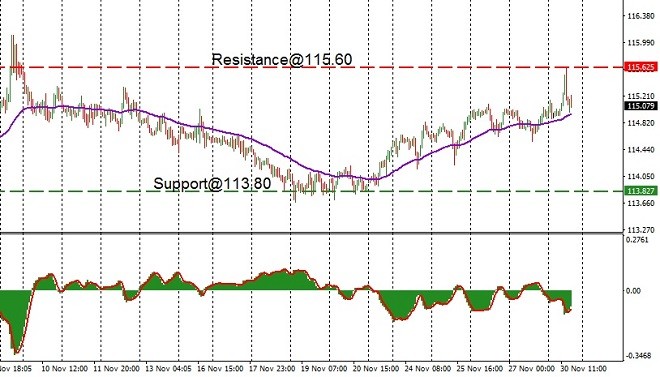
The Swiss Franc remained range-bound against the Japanese yen yesterday following the release of better-than-anticipated economic data from Switzerland and Japan. While the preliminary industrial production data from Japan was impressive, Switzerland’s retail sales data was exceptional. In the past 24 hours, the CHF/JPY pair traded in a range of 114.90 and 115.60.
Data published by the Japanese Ministry of Economy, Trade, and Industry (METI) indicates that preliminary industrial production increased 3.8% m-o-m in October, reflecting the fifth consecutive month of growth, following an expansion of 3.9% in the prior month. The reported reading easily surpassed the market’s expectation of 2.3% growth. A recovery aided the growth in demand for autos and machinery.
Furthermore, the ministry surveyed stated that they anticipate output to increase by 2.7% in November but a decline of 2.4% in December.
Interestingly, output in particular industries has reached levels before the outbreak of Covid-19. Still, the industry ministry cautioned downside risks in the months ahead due to coronavirus cases’ resurgence across the world in recent times.
A 17.9% growth in general machinery production and 6.8% growth in auto production on the backdrop of solid exports led to the total output increase. Likewise, the electrical machinery and information and communication electronic machinery industry recorded 8.4% growth, supported by strong demand for computers.
The ministry maintained its review for October, stating industrial productivity is “picking up.”
As we advance, Takeshi Minami, chief economist at the Norinchukin Research Institute, stated that the rise in industrial output would not continue for a more extended period.
Minami said: “The preliminary reading for October showed a recovery, but as the regions in the northern hemisphere face the winter season and the coronavirus pandemic is expected to spread, the pace of economic recovery will likely slow down.”
He said: “The index is expected to fluctuate also as an increase in auto production, which has been one of the contributors to the output boost in recent months, is forecast to decrease in November and December.”
Back in October, the industrial shipments’ index rose 4.6% to 94.70, while that of inventories declined 1.6% to 95.90.
METI stated that retail sales have rebounded in October, following a massive contraction in a separate news release in the earlier month. Specifically, retail sales increased 6.4% y-o-y in October, following a contraction of 8.7% in the previous month and line with economists’ estimates.
Regarding global economic recovery, Takumi Tsunoda, senior economist at Shinkin Central Bank Research, opined as follows: “There’s a possibility China-bound exports and output will be sluggish if the United States gets worse, and that would spread to China.”
The country’s Prime Minister Yoshihide Suga has directed his Cabinet earlier in November to prepare a stimulus to expedite its economic rebound. The package is anticipated to focus on structural reforms, backing investment in sustainable projects, and increasing output via digitalization.
Legislators have asked the government to set aside an extra sum of between ¥20 trillion and ¥30 trillion ($192.05 billion to $288.07 billion), which will finance a portion of the stimulus plan.
Furthermore, the Ministry of Land, Infrastructure, Transport, and Tourism data indicated that housing starts declined 8.3% y-o-y in October, following a 9.9% contraction in the earlier month and slightly better than the 9% drop anticipated by economists.
In Switzerland, the Federal Statistical Office reported overwhelmingly positive retail sales data. Data provided by the Statistical Organization indicated that the retail sales increased 3.1% y-o-y in October, following a 0.4% growth in the earlier month. Economists had anticipated the retail sales to increase by 0.6% for the reported period.
On a y-o-y basis, retail sales, barring service stations, increased 4.5% after adjusting for sales days and holidays in October. Retail sales of food, drinks, and tobacco recorded a 10.7% rise in nominal turnover. However, the non-food industry recorded a negative 1.1% growth.
Barring service stations, the retail sector recorded a nominal turnover increase of 3.8% m-o-m in October. Retail sales of food, drinks, and tobacco posted a growth of 5.6%, while the non-food sector recorded an increase of 1.8%.
According to the KOF Swiss Economic Institute, the KOF Economic Barometer fell to 103.50 in November, from 106.30 in October, but slightly better than the reading of 101 forecast by economists. The indicator reading reflects the level of optimism that companies’ top management has about their organization’s prospects.
The decline was mainly due to weak indicators from the manufacturing industry and also private consumption. Furthermore, indicators associated with overseas demand and other services sectors also give out a negative signal. On the contrary, indicators linked to accommodation and food service activities, finance, insurance services, and the construction sector stood almost unaltered.
The upbeat economic data from Switzerland and Japan is expected to keep the CHF/JPY pair range-bound with a slight bearish bias.
The historical price chart indicates that the CHF/JPY pair is declining after facing resistance at 115.60. The next support is anticipated only near 113.80. Additionally, the MACD indicator also has a negative reading. Therefore, we are expecting the currency pair to remain range-bound with a slight bearish bias.
Disclaimer: Any financial trading analysis offered here is our opinion and is not intended as advice or direction for investors. We cannot guarantee the success of any trades made as a consequence of this article, and we encourage traders to incorporate a strong money management strategy to limit losses when they enter the markets. Please use this article as part of your own research before formulating strategies prior to trading.