Despite the announcement of a rate hike by the Federal Reserve yesterday, the South African rand rose to its highest level since late August as risk appetite broadly increased among investors. The US Federal Reserve endorsed steady economic growth and rising employment. The rand’s rally was also aided by the country’s President Cyril Ramaphosa’s statement calling the currency ‘steeply undervalued’ against the greenback while promising that his land reform plans will not cause economic chaos. The President is still evaluating whether constitutional amendments are required to make it simpler to confiscate property without any form of compensation.
South African rand and Fed rate hike
While giving an interview to Bloomberg TV in New York, Ramaphosa said: “The rand is undervalued at the moment.” The President has been in attendance at the UN General Assembly and stated: “We want the rand to be well-balanced as to be able to support the economic trajectory of the country.”
According to Mehul Daya, an analyst at Nedbank, the sentiment towards the rand has improved within and outside South Africa. Similarly, analysts at Standard Chartered Pls believes the currency is undervalued and due for another rally.
However, not everyone buys into this argument. Societe Generale SA has stated that the rally seen during the past three weeks is only a temporary bounce back and the rand will begin to decline soon because of poor fundamentals and adverse external factors.
In the past 24-hours, the rand has gained nearly 1.5% to trade at about 14.2011 per dollar. It is the highest gain recorded among the 31 most-traded currencies tracked by Bloomberg.
Last Friday, the President announced a multi-billion dollar economic stimulus package, which includes an R400 billion infrastructure fund aimed at raising money from the private sector. The plan resembles the ideas implemented by India’s Prime Minister Narendra Modi. While India made it a runaway success, analysts doubt whether South Africa will be able to replicate it. The rating agency, Fitch, has stated that the stimulus package may not result in considerable economic expansion. Still, the rand has gained in the past two days, mainly due to the weakness seen in the greenback. Furthermore, investors who are looking for opportunities to invest in emerging markets are seeing potential short-term gains in South Africa.
Mehul Daya said: “Investors have begun searching for value in emerging markets, as the degree of risk premium seems to be well embedded in EM assets after the turmoil experienced so far this year in the EM complex.”
The soft Chinese retaliation to the tariffs announced by President Trump on ~$200 billion worth of Chinese goods has eased global uncertainty and increased investors’ appetite.
Furthermore, in its policy statement, Fed Reserve has removed the word “accommodative,” which means that the US is closer to its neutral peak within the upcoming three or four quarters. The 25 basis points hike, which took the interest rate to a range of 2% to 2.25%, was also priced in the greenback already. All the factors mentioned above have weakened the greenback while strengthening risky assets such as the South African Rand. Therefore, fundamentally, the strengthening of the rand should be used as an opportunity to exit a long position.
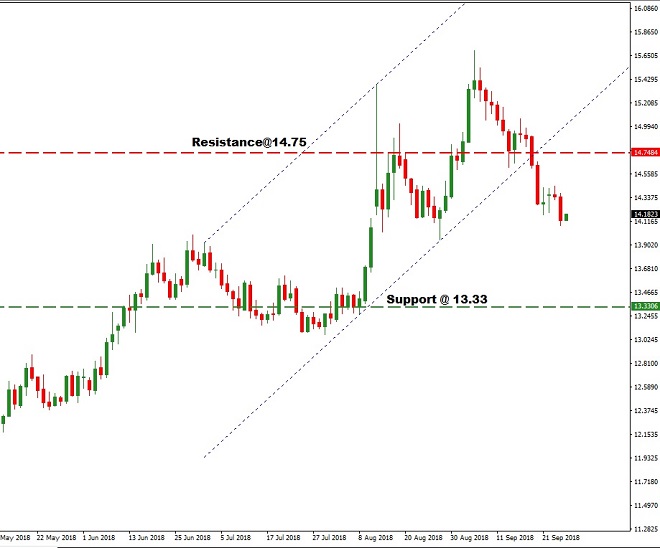
Technically, the USDZAR pair has broken below the lower band of the channel that was acting as a support. The next support is expected only at about 13.33 levels.
Disclaimer: Any financial trading analysis offered here is our opinion and is not intended as advice or direction for investors. We cannot guarantee the success of any trades made as a consequence of this article, and we encourage traders to incorporate a strong money management strategy to limit losses when they enter the markets. Please use this article as part of your own research before formulating strategies prior to trading.