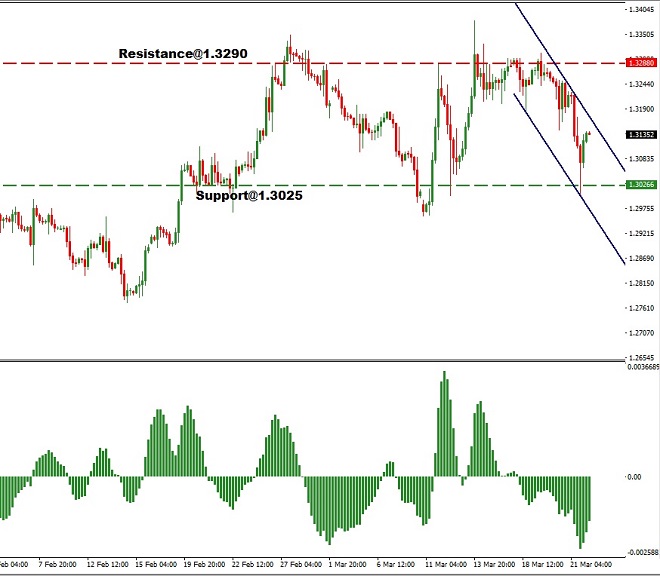
The Sterling pound fell to new lows against the greenback yesterday after being battered by negative Brexit headlines in the early London session. For the rest of the day, the GBP/USD currency pair was in a declining mode, mainly due to rumors that the EU will permit extension of Article 50 only up to May 22nd, which is a relatively short span of time. The GBP/USD pair declined from a high of 1.3208 to a low of 1.3004 before recovering to 1.3129 levels.
Rumors rattle the pound
With just eight days for Brexit, there were reports that the European Commission President, Donald Tusk, had told the UK that a short extension to Article 50 is possible only if MPs vote for the deal proposed by the UK Prime Minister Theresa May. The funny thing about the report is that Tusk was the forerunner in campaigning for a long-term postponement. The reports were brushed away by well-informed traders, while others fell for the news. The rumor sparked a sell-off, leading the GBP/USD pair to 1.3135 levels.
The original statement from Tusk is as follows: “In the light of the consultations that I have conducted over the past days, I believe that a short extension would be possible. But it would be conditional on a positive vote on the withdrawal agreement in the House of Commons.”
This implies the EU could accept Britain’s request to postpone Brexit by one month, provided the UK lawmakers accept Theresa May’s new deal in Parliament next week. An extension may be offered up to May 22nd, a day before European elections begin, only if the MPs endorse the Prime Minister’s withdrawal deal. Notably, May 7th is also a date that is being discussed, shorter than the June 30th request by Ms. May.
The selloff also intensified after news broke out that the Northern Irish DUP is not willing to accept Theresa May‘s current Brexit plan.
The currency pair’s decline temporarily stopped after the Office for National Statistics reported better than anticipated retail sales data for February. The statistics agency reported that the sales volumes increased by 0.4% m-o-m, versus economists’ expectations of a decline. In January, retail sales grew 0.9% on a m-o-m basis.
On Thursday, the ONS provided the chancellor with additional positive news with economic data suggesting that net borrowing by the public sector in February was £ 200 million, down from £1.2 billion in the similar period last year.
Meanwhile, on Thursday, the Bank of England left interest rates unchanged and stated that a majority of business establishments were ready to face a no-deal Brexit. The cable also reacted positively to the monetary policy decision of the Bank of England. The Monetary Policy Committee overwhelmingly voted in favor of maintaining the benchmark interest rate at 0.75% and the asset acquisition facility at £ 435 billion.
Later yesterday, the pound’s steep decline in the American session was sparked by the US dollar’s recovery as tracked by the US Dollar Index, which recorded a high of 96.63.
Overall, the negative sentiments may keep the pound weak for the next few days.
The historical price chart indicates that the GBP/USD pair has bounced off the support at 1.3025. However, the MACD indicator’s reading is yet to turn positive. As a result, we can anticipate the currency pair to remain range-bound between 1.3025 and 1.3190 respectively.
Disclaimer: Any financial trading analysis offered here is our opinion and is not intended as advice or direction for investors. We cannot guarantee the success of any trades made as a consequence of this article, and we encourage traders to incorporate a strong money management strategy to limit losses when they enter the markets. Please use this article as part of your own research before formulating strategies prior to trading.