The Australian dollar is presently selling off against G10 currencies, mainly the US dollar and the Japanese yen. The selloff was sparked by the dovish interest rate statement made by the Reserve Bank of Australia (RBA). The market now believes that there is a small chance for monetary tightening, which is expected sometime in 2019.
Australia’s wage growth and inflation issues
The RBA maintained its interest rate at a record low level of 1.5% for the 27th consecutive month, quoting low inflation and a variety of factors likely to postpone the rise of the consumer price index towards the upper end of the 2% to 3% target range.
In the statement that accompanied the monetary policy, RBA Governor, Philip Lowe, said: “Taking account of the available information, the Board judged that holding the stance of monetary policy unchanged at this meeting would be consistent with sustainable growth in the economy and achieving the inflation target over time. The low level of interest rates is continuing to support the Australian economy.”
Interest rate changes or clues are only given as a reply to changes in inflation but affect currencies due to the push and pull effect they have on global capital flows and their attraction for short-term speculators.
RBA governor, Philip Lowe, opined that the outlook for both domestic, as well as global economies is positive but that domestic inflation pressures are way too weak for the central bank to consider a hike in interest rate. On this basis, Lowe warned that inflation might not match the expectations of both RBA officials and the market through 2018.
The governor said: “Inflation is around 2 percent. The central forecast is for inflation to be higher in 2019 and 2020 than it is currently. In the interim, once-off declines in some administered prices in the September quarter are expected to result in inflation in 2018 being a little lower than otherwise.”
Regarding Australia’s labor market, Lowe stated that he expects the economy to continue generating jobs at a decent rate and that this will ultimately result in a further pickup in wage growth, which should improve the inflation outlook.
However, Lowe cautioned that the situation in the Sydney and Melbourne housing markets are not good at this point and that credit conditions are tightening, and funding pressures have encouraged domestic lenders to hike their interest rates.
Echoing similar views, Sally Auld, an analyst at JP Morgan, said: “In aggregate, credit conditions are tighter, but mortgage rates are low, and there is competition for good quality borrowers.”
The Australian dollar simply moves as a function of changes that happen across financial markets. Yesterday, Hong Kong’s Hang Seng Index plunged while the Shanghai Composite remains shut down for China’s ‘Golden Week’ holidays. In Europe, financial markets are seeing a selloff following three-quarters of declining economic growth. Italian government bond prices are plunging as the government implements efforts to raise deficit spending. As risk sentiment falls apart globally, traders are getting out of ‘risk on’ currencies such as the Australian dollar and going at the back of safe-haven assets such as the Japanese yen and US Treasury bonds which keeps the Australian dollar bearish.
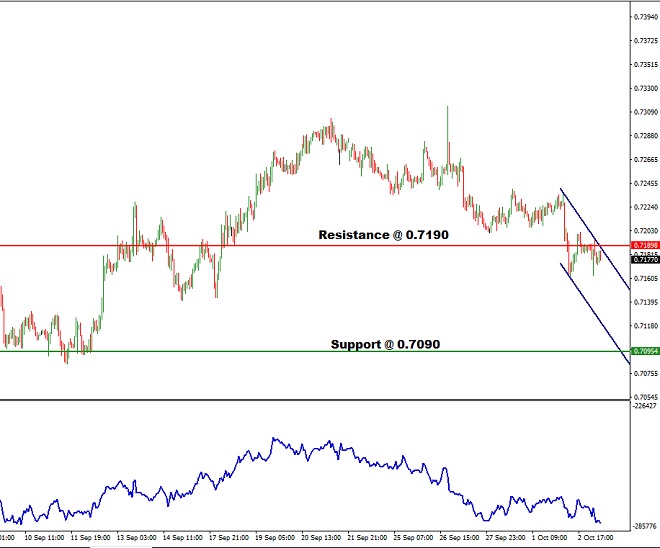
Technically, against the greenback, the Aussie is moving along a declining channel in the historical price chart. The accumulation/distribution indicator is making new lows, and we can expect the bearishness to continue in the short-term.
Disclaimer: Any financial trading analysis offered here is our opinion and is not intended as advice or direction for investors. We cannot guarantee the success of any trades made as a consequence of this article, and we encourage traders to incorporate a strong money management strategy to limit losses when they enter the markets. Please use this article as part of your own research before formulating strategies prior to trading.