Video Source: Sky News Australia on YouTube
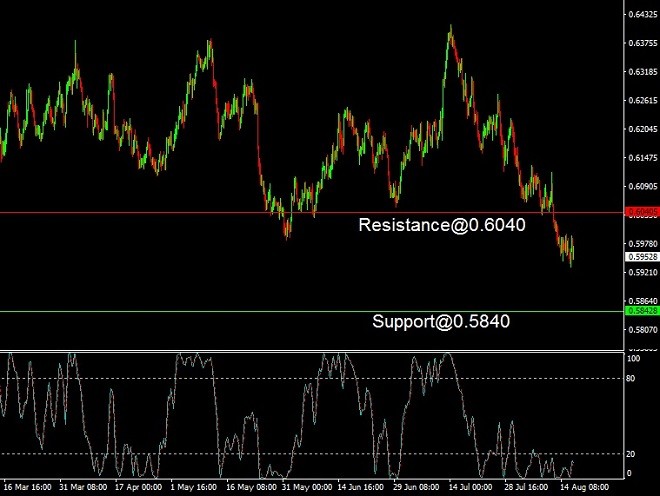
The Kiwi dollar declined against the greenback yesterday following the Reserve Bank of New Zealand’s decision to leave the benchmark interest rate unchanged. The US industrial production data for July also surpassed estimates. This enabled the US dollar to gain ground against the New Zealand dollar. Overall, the NZD/USD pair declined from a high of 0.6040 to a low of 0.5936 in the past 24 hours.
Following the monetary policy meeting, the Reserve Bank of New Zealand (RBNZ) announced its decision to keep the official cash rate (OCR), or benchmark interest rate, unchanged at 5.50%. This is the second consecutive month of rate pause by the RBNZ after raising rates for 18 months to fight inflation, and it is in line with economists’ estimates.
The country’s inflation is at 6%, down from a peak of 7.30%. While making the interest rate announcement, the New Zealand central bank also stated that further hikes could come in the months ahead, if necessary.
The market now expects the benchmark interest rate to be 5.60% until the end of September 2024, when inflation is forecast to decline to the central bank’s targeted range of 1% to 3%, specifically 2.70%.
The board pointed out that the monetary environment is limiting consumer spending and minimizing cost pressure after an aggregate rate hike of 525bps since October 2021.
Nevertheless, as per the RBNZ, inflation remains very high, and the benchmark interest rate should stay at a particular level to bring inflation down to the targeted level of 1% to 3% by the second half of 2024. The policy committee also cautioned against the possibility that both activity and inflation metrics might not decelerate to the extent anticipated.
In the medium term, the central bank expects a slowdown in demand across the barriers, specifically in China. Therefore, it could hurt New Zealand’s export proceeds.
The RBNZ also forecasts the benchmark interest rate to peak at or slightly higher than the current level but does not anticipate any rate cuts until the first half of 2025.
Following the negative GDP growth of 0.70% and 0.10% in the last two quarters, New Zealand is officially in a recession. The central bank has assessed a likely GDP growth rate of 0.50% in the June 2023 quarter. However, the country is still expected to face economic contractions of 0.30% and 0.10% in the current and next quarters.
According to the US Census Bureau, the county’s building permits were 1,442,000 units in July, up 0.10% from 1,441,000 in the previous month, but missed forecasts of 1,470,000 units.
The reported figure is 13% lower than 1,658,000 units in July. Single-family building permits were 930,000 units in July, an increase of 0.60% above 924,000 units in June.
Furthermore, the Census Bureau stated that housing starts were 1,452,000 units in July, an increase of 3.90% from 1,398,000 units in June and line with economists’ estimates. The reported figure is 5.90% higher than 1,371,000 units in July. Single-family housing starts were 983,000 units in July, up 6.7% from 921,000 units in June.
According to the data published by the US Federal Reserve, the country’s industrial production inched up 1% m-o-m in July, following a 0.80% decline in the previous month and greater than forecasts of 0.30% growth.
The reported reading reflects the largest expansion in six months. The increase was led by a 0.50% rise in manufacturing output, surpassing forecasts of a no-change reading. Specifically, manufacturing of motor vehicles and parts surged 5.20%, while factory output inched up 0.10%. Mining output rose by 0.50%, while utility output grew by 5.40%m-o-m in July.
The Federal Reserve also stated that the US capacity utilization increased to 79.30% in July from 78.60% in June. Economists had anticipated a reading of 79.10%. However, the reading is 0.40% below the long-term average.
The solid US economic data and RBNZ’s decision to maintain interest rates are expected to keep the NZD/USD pair slightly bearish in the short term.
The historical price chart indicates that the NZD/USD pair is descending after breaking the support at 0.6040. The next major support is anticipated only near 0.5840. Additionally, the currency pair is trading below its 50-day moving average, while the stochastic indicator is in the bearish zone. Therefore, we anticipate the NZD/USD pair to remain in a downtrend in the short term.
Disclaimer: Any financial trading analysis offered here is our opinion and is not intended as advice or direction for investors. We cannot guarantee the success of any trades made as a consequence of this article, and we encourage traders to incorporate a strong money management strategy to limit losses when they enter the markets. Please use this article as part of your own research before formulating strategies prior to trading.