

The British Pound rallied against the greenback in the European session yesterday after the data from the UK’s Nationwide Building Society (NBS) indicated that house prices rose at the quickest rate in over a year in January. However, the bullish sentiment didn’t last long as traders started reducing their exposure to the pound as the Bank of England is scheduled to announce their interest rate decision after the policy meeting today.
As the interest rate decision is too close to call, prudent traders have started unwinding their long positions. After opening at 1.2995, the GBP/USD pair rose to a high of 1.3015. However, selling pressure pushed the currency pair to a low of 1.2990.
The house prices increased at a quicker-than-anticipated rate of 1.9% y-o-y in January, led by low-interest rates and strengthening of the labor market situation, according to the NBS. Economists anticipated house prices to increase by 1.5%. In December, the house prices rose by 1.4% on a y-o-y basis.
Furthermore, house price inflation quickened to 0.5% on a m-o-m basis, from 0.1% in the previous month. The reported figures also surpassed economists’ forecast of 0.2%. Looking forward, Robert Gardner, Nationwide’s chief economist, stated that economic developments would lead to housing market trends and prices.
Gardner believes that the economy will grow at a moderate pace this year, while house prices will almost remain flat in the same period.
Paul Spirgel, an options analyst at Thomson Reuters, believes that an interest rate cut or dovish statement by the BoE would trigger another round of sell-off in the GBP/USD pair. Spirgel said, “A rate cut or dovish commentary by the BoE is likely to test 2020 lows and open the way for further losses near the 100-DMA at 1.2852 and the 200-DMA by 1.2692.”
Philip Shaw, an economist at Investec, does not want to brush away the possibility of a rate cut this year, even though the possibilities are slim. Shaw said, “We are not ruling out the prospect of rates coming down at some stage this year. Instead, we are arguing that given recent evidence, economic conditions do not currently appear to justify an easing in policy. That said we expect the economy to carry a modest degree of momentum and our base case remains that the Bank rate will remain at 0.75% throughout 2020.”
In the US, the Census Bureau reported a decline in preliminary wholesale inventories by 0.1% on a m-o-m basis in December. In November, wholesale inventories declined by 0.1%. Economists had anticipated wholesale inventories to increase by 0.1% in December.
The upcoming BoE’s interest rate decision is expected to keep the pound volatile today. As Sterling has been declining on the expectation of a rate cut, the chances of a strong rebound of the pound are higher if the interest rates are left unchanged. Traders need to remain cautious.
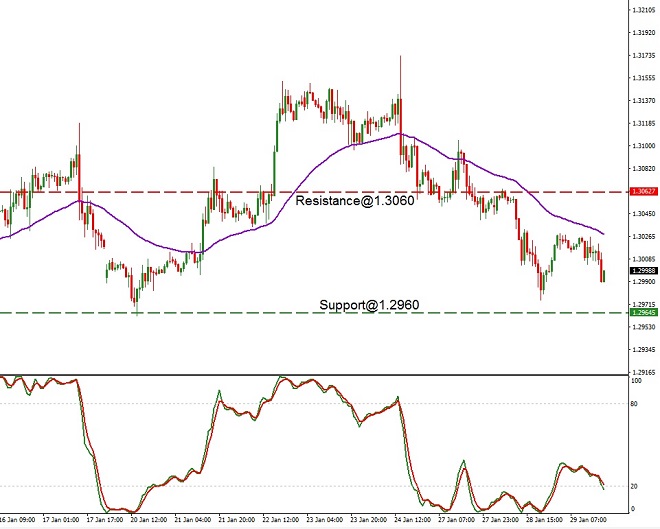
The historical price chart indicates that the GBP/USD pair is declining after facing resistance at 1.3060. The next major support is anticipated near 1.2960. While the currency pair is trading below its 50-day moving average, the stochastic oscillator is in the bearish zone. Therefore, we can expect the GBP/USD pair to remain in a downtrend in the short-term.
Disclaimer: Any financial trading analysis offered here is our opinion and is not intended as advice or direction for investors. We cannot guarantee the success of any trades made as a consequence of this article, and we encourage traders to incorporate a strong money management strategy to limit losses when they enter the markets. Please use this article as part of your own research before formulating strategies prior to trading.


