The Sterling pound recorded its daily low against the greenback in the early European session on Friday after the news broke that the UK government has hardly made any progress in its cross-party Brexit talks. However, the GBP/USD currency pair reversed trend in the US session following the report of weak US non-manufacturing/services PMI.
The market, surprisingly, discarded the upbeat US jobs data. From a low of 1.2987, the GBP/USD currency pair rallied to close near the day’s high of 1.3160.
On Friday, the GBP/USD pair started trading sideways during the Asian session before declining in the early London session. The pair fell sharply after Labour Party leader Jeremy Corbyn informed reporters that the Brexit debate would again escalate to Parliament if both parties don’t reach an understanding. Corbyn’s statement sparked concerns that Theresa May‘s government is reluctant to show flexibility on main issues.
Investors also believe that Britain would have no other option other than participating in the European Parliament elections scheduled to happen later this month. However, the currency pair’s decline was not too deep because of the upbeat Markit/CIPS UK services PMI reported in the early European session.
UK service providers reported an increase in business activity in April, signaling a return to growth path following the minor contraction recorded in the earlier month. The seasonally adjusted IHS Markit Services PMI Business Activity Index stood at 50.4 in April, an increase from a 32-month low of 48.9 reported in March.
In the US session, the Bureau of Labor Statistics (BLS) stated that the US economy added 263,000 new jobs, versus the market’s expectation for a monthly gain of 217,000. The US unemployment rate now stands at a 49-year low of 3.6%, down from 3.8% in March.
Almost all the main sectors recorded job gains, including business and professional services (76,000), manufacturing (4,000), healthcare (27,000), government (27,000), and construction (33,000). Only three sectors of the economy reported job losses. They are retail (12,000), mining and logging (3,000), and utilities (3,200).
The labor report also pointed out that average hourly wages increased by 0.2% or six cents to $27.77 per hour. The 12-month wage rate remained unchanged, but it was still up 3.2%. In April, the number of hours worked declined by 0.1 hours to 34.4 hours.
In other economic data, the US Census Bureau revealed that the US goods trade deficit widened 0.7% to $71.4 billion in 1Q19, matching markets expectations for a trade deficit of $72 billion. Imports increased at a faster pace than exports. While the import of automobiles, food, and industrial supplies increased, exports were led by agricultural products.
The report also pointed out that advanced retail inventories declined by 0.3%. Notably, factory orders increased 1.9% in March, an increase from the 0.3% contraction in the earlier month. There was no change in wholesale inventories in March.
Likewise, the Institute for Supply Management reported a decline in non-Manufacturing PMI to 55.5 in April, from 56.1 in March, and missed the market’s expectation of 57.
Commenting on the data, Anthony Nieves, Chair of the Institute for Supply Management (ISM) Non-Manufacturing Business Survey Committee, said: “The non-manufacturing sector has experienced an uptick in business activity, but in general, there has been a leveling off. Respondents are still mostly optimistic about overall business conditions, but concerns remain about employment resources.”
The market, however, discarded the positive jobs data and gave importance to the widened trade deficit and weak manufacturing PMI. As a result, the GBP/USD reversed trend to reach a high of 1.3161 in the final hour of trade.
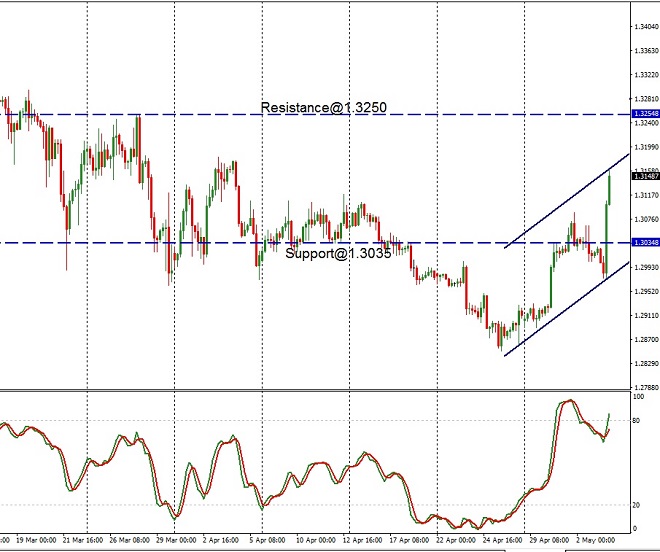
The historical price chart indicates that the GBP/USD currency pair has found support at 1.3035. The stochastic oscillator is also in the bullish zone. The next resistance for the GBP/USD pair is only at 1.3250. As a result, we can expect the currency pair to move up in the short-term.
Disclaimer: Any financial trading analysis offered here is our opinion and is not intended as advice or direction for investors. We cannot guarantee the success of any trades made as a consequence of this article, and we encourage traders to incorporate a strong money management strategy to limit losses when they enter the markets. Please use this article as part of your own research before formulating strategies prior to trading.