Notwithstanding a plethora of warnings related to the Chinese domestic economy and the overall bearish sentiment, the yuan continues to hold its ground against the greenback. In the past few months, Beijing has seen a substantial slowdown, primarily due to the tariff war between the United States and China. Although it appears that both parties are moving towards a new trade agreement, skepticism about overall growth is still rising. At the time of writing this article, the USD/CNY currency pair was trading almost flat at 6.76693.
Yuan holds ground despite China slowdown
As investors across the globe are eagerly waiting for a trade deal between the US and China to be announced, there is another crucial factor that could contribute to the growth of the world’s second-largest economy: stimulus from Beijing.
The government has already disclosed a vast amount of stimulus measures in the past few months to trigger growth. Along with traditional methods of economic stimulus, the Chinese government has also announced tax cuts for several industrial sectors, consumer credits to encourage spending, and reductions in the reserve requirement ratio to increase lending by banks. Experts believe that this could be the only way to bring the economy to a growth track if trade talks collapse.
Infrastructure will ostensibly play a key role in stimulating the economy.
The government is expected to clear infrastructure projects worth $220 billion this year, according to the National Development and Reform Commission (NDRC), the country’s top economic planner. Transport will dominate stimulus spending, most of which will be allotted to public transport and rail projects, such as the modernization of the Intercity Rail Network in Eastern Guangdong and Shanghai Urban Rail Transit.
However, JPMorgan Chase believes that it might not be enough. In a research note sent to clients, the investment banking giant has warned that rising private and public debt threatens growth.
JP Morgan Chase report says: “The major worry regarding financial stability and the sustainability of economic growth has been China’s burgeoning debt problem, particularly in the private sector.”
The rise in the number of state-owned zombie companies with weak balance sheets is another vital risk that needs to be tackled urgently. The financial institution has also pointed out that the People’s Bank of China( PBOC) may have to look at the option of introducing sub-zero interest rates to prevent the economy from softening further.
While acknowledging the need to monitor the US-China discussions, Zhiang Xin, the CEO of Soho China and a female billionaire, opined that she does not expect an economic collapse. “Right now, because the trade talks have not quite reached an agreement yet, so the sentiment in China is relatively weak. I think the sentiment matters a lot. And an economy is about sentiment, the economy is about confidence.”
In this regard, a UN trade official has cautioned that the US plan to hike import duties on Chinese goods next month would have a “massive” effect on the global economy.
If both sides fail to sign a new trade deal by the 1st of March, the US intends to significantly increase tariffs on Chinese goods. The US and China have a March 1st cutoff date to reach an agreement, or the US has said that import tariffs will increase from 10 percent to 25 percent on Chinese goods worth $200bn (£152bn).
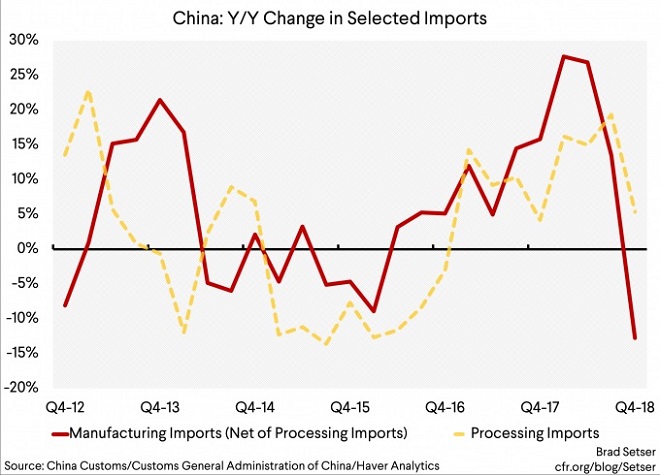
The UN Conference on Trade and Development (Unctad) estimates that the Asian producers will be the hardest hit, with a projected $160 billion reduction in the region’s shipments. As the image below shows, there is already a significant slowdown in Chinese imports. All these factors suggest that the yuan will cool down in the days ahead.

Disclaimer: Any financial trading analysis offered here is our opinion and is not intended as advice or direction for investors. We cannot guarantee the success of any trades made as a consequence of this article, and we encourage traders to incorporate a strong money management strategy to limit losses when they enter the markets. Please use this article as part of your own research before formulating strategies prior to trading.